Behind the Scenes: How We Assess a New Client Site Before Deploying Guards
A guard standing at your gate is only the visible part of the job. The real work happens a day or two earlier, when one of our consultants walks the property with a notebook, asks questions most site owners never think to answer, and quietly decides how that particular location needs to be protected.
This is the part clients rarely see: the site assessment that happens before a single guard is scheduled. It’s also the part that decides whether the guards who show up actually match the risks a property faces, or whether they are simply filling a shift. Here’s what that process looks like at Clutch Security Services, and why we treat it as the most important hour of any new client relationship.
Why We Never Deploy Guards Without a Site Assessment First
Every property is different. Two branches of the same bank can end up needing different coverage once you actually look closely. A retail store on a busy market road faces different risks than a warehouse on the outskirts of the city, and a corporate office has different traffic patterns than a textile unit running through the night. Sending the same number of guards to every address, without checking what’s actually there, is how properties end up either under protected or paying for coverage they don’t need.
That’s why the first thing we do for any new client, before a single guard is scheduled, is send a consultant to walk the property in person.
Walking the Boundary First: Gates, Walls and Entry Points
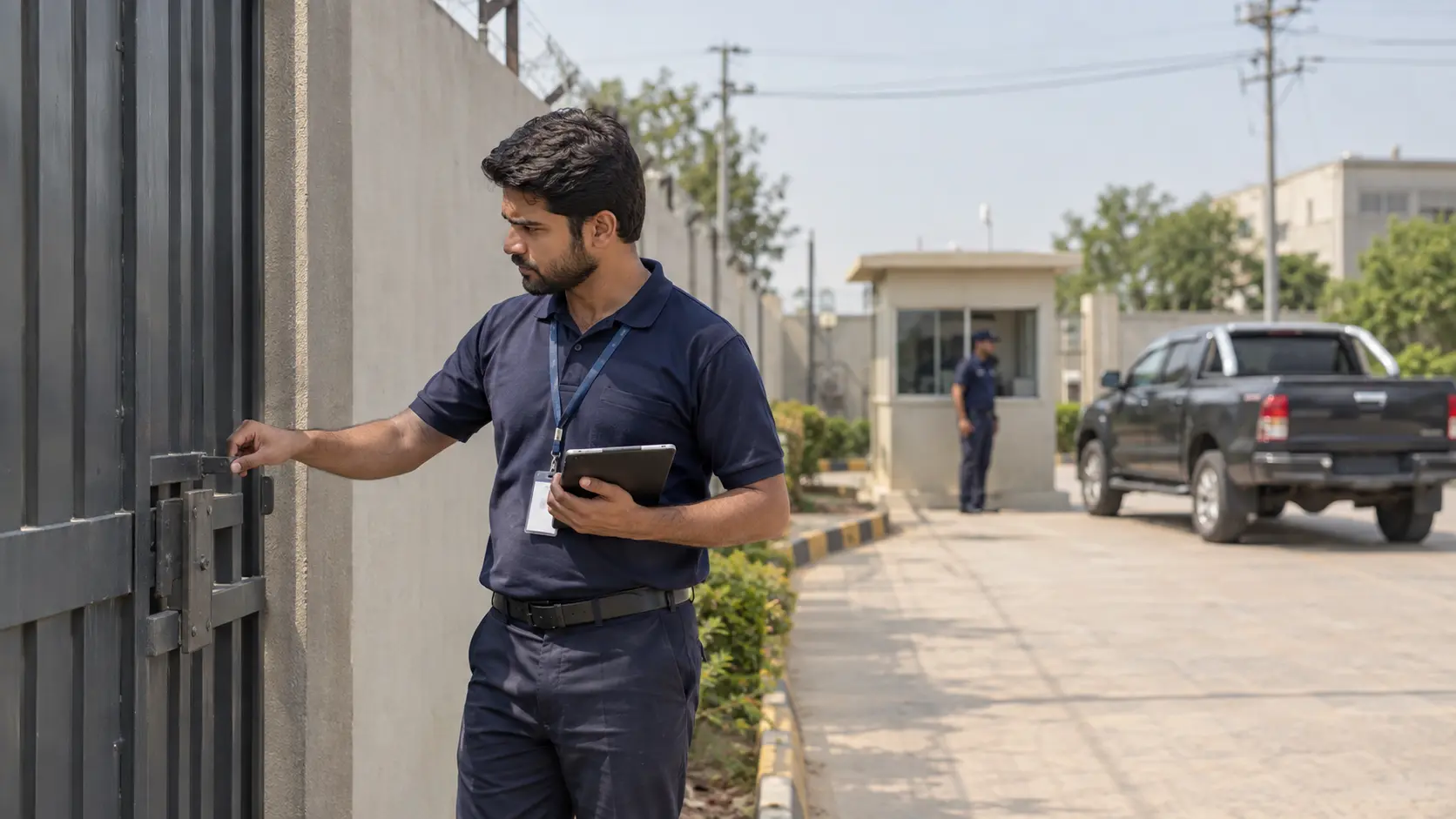
The walkthrough usually starts at the boundary. Our consultant checks the main gate, any side or staff entrance, and the loading or service gate separately, since each one gets used differently and needs its own rule for who gets through. Boundary walls get inspected for height, cracks, and any section low enough or overgrown enough to make climbing easy.
In older neighbourhoods and industrial areas, we also look at what sits behind the property. A narrow service lane, a plot still under construction, or a rooftop from a neighbouring building can all turn into an entry point nobody planned for. This part of the visit alone tells us a lot about how many static posts a location actually needs.
Finding the Blind Spots Before Anyone Else Does
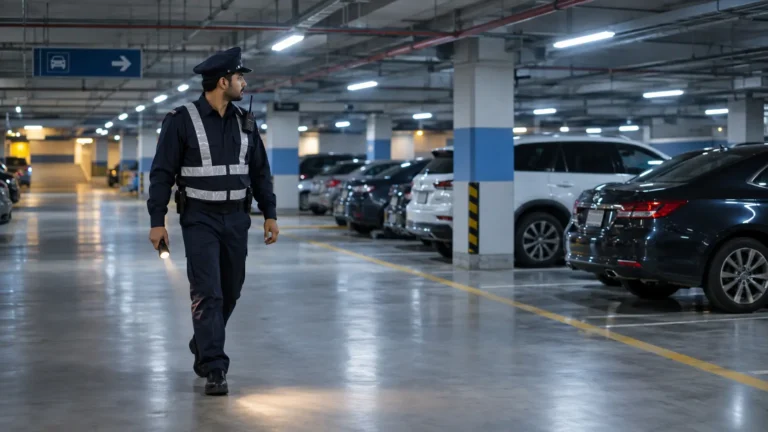
After the perimeter, attention moves inside. We walk through parking areas, staircases, storage yards, and any part of the property where movement isn’t easy to observe from a fixed post. Poor lighting shows up fast on an evening visit, since a corner that looks fine at noon can turn into a blind spot after sunset.
If cameras are already installed, we check where they actually point rather than trusting a site plan, because camera angles drift, get blocked by new construction, or simply miss areas nobody thought to test. A camera that has been quietly facing a wall for six months does a client no good at all.
Checking What’s Already Protecting the Property
Most properties already have some form of protection before we arrive, even if it’s just a lock and an older watchman who has worked there for years. Part of our review covers what already exists and whether it still works. Cameras that record but never get monitored, alarm systems nobody remembers the code for, and gates that stay open because the latch broke months ago are more common than people expect.
Power backup matters too. A camera system is only useful if it keeps running through load shedding, so we check whether cameras and lighting sit on a UPS or generator circuit before recommending anything new. There’s little point in adding equipment to a setup that goes dark every time the power cuts out.
Understanding the Business, Not Just the Building
A building tells us about walls and gates. The business tells us about risk. Before finalising any recommendation, we sit with the client or the facility manager and ask what kind of property this actually is. A bank branch or a jewellery showroom carries different risk than a school or a residential society, and a factory running three shifts needs a different coverage pattern than an office that empties out by seven in the evening.
We also ask about anything that has happened before: a break in attempt, a theft, a dispute with a previous guard company. Past incidents usually point straight at the gap that still needs closing.
Talking to the People Who Already Work There
The people already on a property usually know it better than any document could show. Receptionists know which visitors cause problems. Facility staff know which door gets propped open for deliveries. An existing watchman knows which hour of the night feels the quietest, and the most exposed.
We make a point of asking these questions directly. A five minute conversation with someone who has worked the property for two years often reveals more than an hour of walking around alone.
How Long a Proper Site Assessment Takes
A thorough assessment does not take days. For most properties, one visit covering an hour or two is enough for our consultant to walk the boundary, check existing equipment, and speak with whoever manages the location day to day. Larger sites, like a factory complex or a multi building corporate campus, sometimes need a second visit or a follow up call to confirm a few details.
Either way, this step fits comfortably inside our standard deployment window. Being thorough doesn’t mean making a client wait weeks for protection that should already be in place.
Turning the Walkthrough Into an Actual Guard Deployment Plan
Every finding from the visit feeds into a plan, not a guess. Guard numbers, whether personnel should be armed or unarmed, shift timing, patrol routes, and even where the first post gets positioned, all come from what was actually observed at the property rather than a standard package applied to every address.
A textile unit with a loading bay open through the night needs a different plan than a corporate office with one main entrance and a nine to five schedule. This is also where we decide how often a field supervisor should visit, since a higher risk property needs closer, more frequent checks than a lower risk one.
Why This Step Protects Your Investment, Not Just the Property
Skipping this step is one of the easiest ways a security contract goes wrong. Guards get placed based on guesswork, coverage stops matching the actual risk, and problems only surface after something has already gone missing or someone has already gotten through.
At Clutch Security Services, the site visit is not a formality before the paperwork. It is the step that decides everything else: how many guards a property needs, what kind of guards, and exactly where they should stand. If a provider ever offers to deploy guards without visiting your property first, that is usually worth asking about before signing anything.
If you’re getting ready to bring in security for a new property, or you are not sure whether your current guards were ever placed based on a real assessment, our team can help. Contact Clutch Security Services and we’ll arrange a site visit, usually within a day or two, before recommending anything.