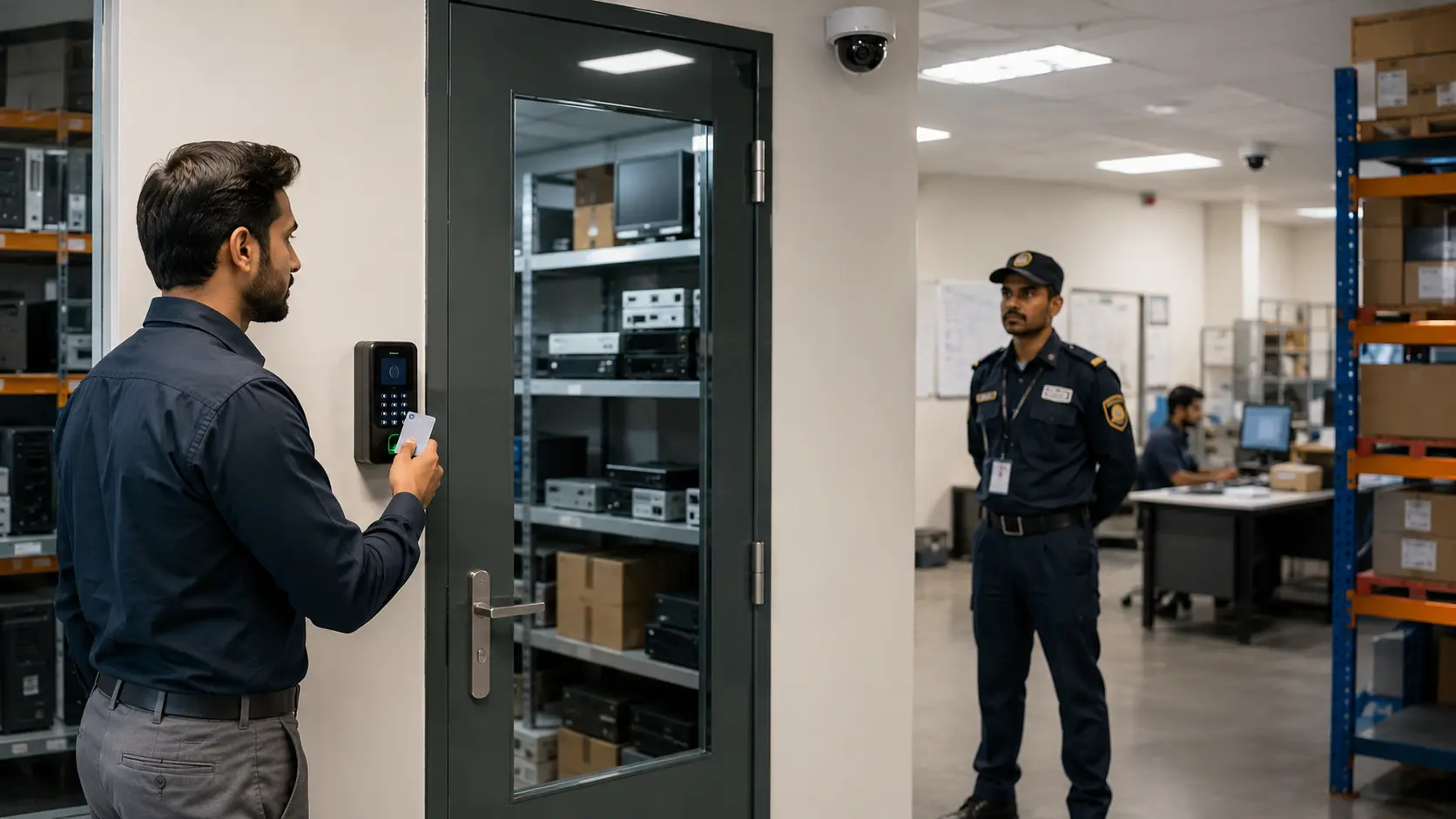
How Access Control Reduces Internal Theft in Businesses
Internal theft can be difficult for businesses to detect because the person involved may already have legitimate access to the workplace. An employee may know where valuable inventory is stored, when certain areas are unattended, and which security procedures have weaknesses.
This is where access control reduces internal theft by limiting who can enter sensitive areas and creating a clear record of access activity.
A strong access control strategy does not simply keep outsiders away. It also helps businesses control employee access, protect high value assets, improve accountability, and identify unusual activity before a small loss becomes a major problem.
For offices, warehouses, factories, retail stores, financial institutions, and other commercial properties, combining access control with trained security personnel can create a much stronger security environment.
What Is Internal Theft?
Internal theft refers to the unauthorized removal or misuse of a company’s property, inventory, cash, equipment, information, or other assets by someone who has legitimate access to the business.
The risk can come from employees, contractors, temporary workers, vendors, or other individuals who are permitted to enter the property.
Unlike an external burglary, internal theft can be harder to identify because there may be no obvious forced entry. The individual may already have a key, access card, workplace credentials, or permission to enter certain parts of the property.
That makes employee theft prevention an important part of an overall business security strategy.
How Access Control Reduces Internal Theft
Access control gives businesses more control over who can enter specific areas, when they can enter, and what activity can be reviewed later.
Here are some of the main ways it helps reduce internal theft.
1. It Limits Access to Sensitive Areas
Not every employee needs access to every part of a business.
A warehouse worker may need access to the loading area but not the finance office. An office employee may need access to their department but not a secure storage room. A cleaner may need access during specific hours but not overnight.
An effective access control system allows businesses to restrict entry according to job responsibilities.
Sensitive areas can include:
- Stock rooms
- Warehouses
- Cash handling areas
- Server rooms
- Management offices
- Records rooms
- Equipment storage areas
- Restricted production zones
The basic principle is simple: employees should only have access to the areas required for their work.
Restricting unnecessary access can reduce opportunities for unauthorized removal of assets.
2. It Creates Individual Accountability
Shared keys and unrestricted access make it difficult to determine who entered a particular area.
Modern access control systems can assign individual credentials to employees. Depending on the system, these may include access cards, PINs, biometric identification, or other authentication methods.
This creates a stronger accountability trail.
Instead of knowing that “someone entered the storage room,” management may be able to determine which credential was used and when the entry occurred.
Access records can also support investigations when inventory discrepancies or suspicious activity are discovered.
Clutch Security Services specifically includes access control as part of its security operations, with guards verifying employee credentials, screening visitors, and maintaining access logs.
3. It Helps Prevent Unauthorized Entry
Internal theft does not always involve someone stealing directly from their assigned workplace.
An employee may enter another department, storage room, back entrance, or restricted facility without authorization and remove property from an area they normally would not access.
Controlled entry makes this more difficult.
For example, a staff member may be authorized to work on the sales floor but have no legitimate reason to enter the inventory room after business hours. Restricting that door can prevent unnecessary access and make suspicious attempts easier to identify.
This is particularly useful for businesses with multiple departments, large warehouses, factories, and properties with several entry points.
4. Access Can Be Restricted by Time
Access control is not only about deciding who can enter. It can also determine when they are allowed to enter.
A business may allow certain employees to access a particular area during normal working hours while restricting access during nights, weekends, holidays, or other periods when the area should be closed.
This can help protect assets during periods when fewer employees and managers are present.
For example, a warehouse employee may have authorized access from 9 AM to 6 PM. An attempted entry at 2 AM would immediately stand out as unusual and could trigger further investigation.
5. Access Logs Support Theft Investigations
No security system can guarantee that internal theft will never happen.
The value of access control is that it can provide useful information when something goes wrong.
Suppose a business discovers that inventory worth a significant amount is missing. Management can review access activity around the storage area and compare it with inventory records, CCTV footage, shift schedules, and other information.
This can help narrow down when unauthorized activity may have occurred.
Access records therefore serve two purposes:
Deterrence: Employees know that access may be recorded.
Investigation: Management has information that can help establish what happened.
Security systems can also provide recorded evidence that supports incident investigations.
6. It Reduces the Risk Created by Shared Keys
Traditional keys create several problems for businesses.
A key can be copied, misplaced, borrowed, or retained after an employee leaves the organization. If multiple people use the same key, there is no reliable way to know who unlocked the door.
Digital access credentials provide greater control.
Businesses can issue individual credentials and remove them when an employee changes roles or leaves the company. This helps prevent former employees from retaining physical access to restricted areas.
For companies managing many workers, contractors, and temporary staff, this level of control can be particularly valuable.
7. It Works With CCTV and Security Guards
Access control works best when it is part of a wider security strategy.
For example, a company can combine access credentials with CCTV surveillance and trained security personnel.
An access control system may show that a specific credential was used to enter a restricted room at a certain time. CCTV can then help verify the person involved, while a security guard or supervisor can respond to suspicious behavior.
This combination creates multiple layers of protection rather than depending on a single security measure.
Clutch Security Services combines technology such as access control and CCTV with trained personnel and supervision to create an integrated security approach.
Which Business Areas Need Strong Access Control?
Some locations present a much higher theft risk than others.
Businesses should pay particular attention to areas containing valuable, sensitive, or easily transferable assets.
Warehouses
Warehouses can contain large quantities of inventory, making them attractive targets for internal and external theft.
Controlled access can help limit who enters storage areas and loading zones.
Retail Stores
Retail businesses can use access restrictions for stockrooms, cash offices, management areas, and other restricted spaces.
Factories
Manufacturing facilities may have expensive machinery, raw materials, finished goods, tools, and sensitive production areas that require controlled access.
Offices
Corporate offices may need restricted access for server rooms, financial records, executive offices, confidential documents, and other sensitive areas.
Banks and Financial Institutions
Financial facilities require strict controls around cash handling areas, secure rooms, employee-only zones, and other high-risk locations.
Construction and Industrial Sites
Construction and industrial properties may contain valuable equipment, tools, materials, and machinery that require controlled entry and monitoring.
Access Control Should Not Replace Security Guards
Technology is valuable, but it should not be treated as a complete replacement for trained security personnel.
A card reader may identify whether a credential was used. It cannot physically question a suspicious visitor, monitor a crowded entrance, respond to an incident, or conduct a patrol around a property.
Human supervision adds an important layer of protection.
Professional guards can verify employee credentials, screen visitors, monitor access points, maintain visitor records, patrol vulnerable areas, and respond when suspicious activity is detected. Clutch Security Services provides these functions alongside ongoing supervision and site specific security planning.
For many businesses, the strongest approach is a combination of:
Access control + CCTV + trained security guards + visitor management + regular supervision
Each layer addresses a different part of the security problem.
Best Practices for Internal Theft Prevention
Businesses looking to improve internal theft prevention should avoid relying on access control alone.
Start by identifying areas where theft would cause the greatest financial or operational damage. Review which employees currently have access to those locations and remove unnecessary permissions.
Use individual credentials rather than shared access wherever possible.
Review access permissions regularly, particularly after employee transfers, promotions, resignations, and terminations.
Keep access records and investigate unusual activity instead of allowing repeated exceptions.
Combine access logs with CCTV surveillance, inventory checks, visitor management, and physical security.
Finally, make sure security personnel understand exactly which areas require additional attention.
Protect Your Business From Internal Theft
Do not wait until missing inventory, equipment, or cash becomes a serious financial problem. A properly planned access control strategy can help you identify vulnerable areas, limit unnecessary access, and strengthen accountability across your property.
Contact Clutch Security Services to discuss your security requirements and develop a protection plan suited to your business.