A Complete Guide to Security Guard Services Across Different Areas of Lahore
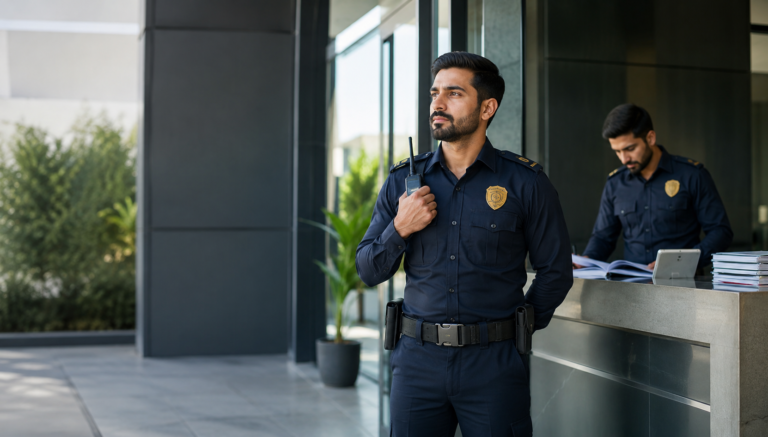
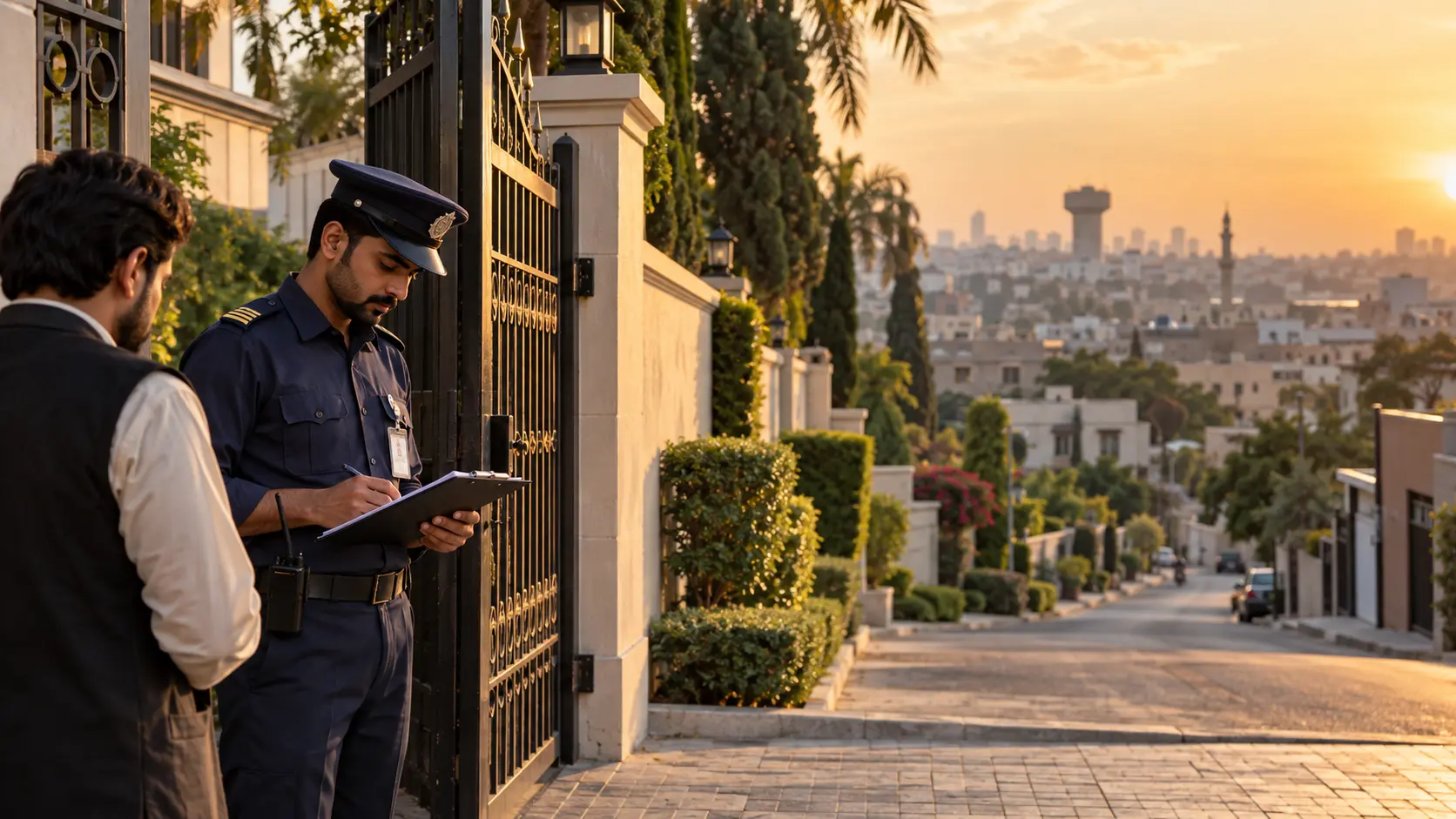
A guard posted outside a bungalow in DHA Phase 6 spends most of a shift managing a quiet street and a handful of familiar faces. Move that same guard to Liberty Market on a Saturday evening, and quiet is the last word he would use to describe the job.
Lahore doesn’t run on one risk profile. It runs on dozens of them, stitched together across a city that grew outward in fits and starts rather than by a single master plan. A half built plot on the edge of Sundar, a kanal house behind a tall boundary wall in DHA, a narrow gali in the Walled City packed with shoppers well past dark: each of these needs something different from a guard, in headcount, in training, in what watching the property actually means on a given shift.
Clutch Security Services works across Lahore’s housing societies, commercial strips, older markets and industrial belts, and this guide walks through what changes from one part of the city to another, and what a proper deployment needs to account for in each.
DHA and Lahore’s Larger Housing Societies
Defence Housing Authority traces back to 1973, when it started life as the Civil and Defence Housing Society before becoming the Lahore Cantonment Co-operative Housing Society two years later. It only took the name DHA in 1999, and what began as a scheme built almost entirely for army personnel has grown into a society open to any civilian who can afford a plot. Today DHA accounts for roughly a quarter of Lahore’s total area, expanding from its original phases into more than a dozen today, stretching from the old Cantt side out toward Bedian Road and Raiwind Road.
That scale is exactly what makes security here inconsistent from one block to the next. A house in an older phase near Cantt often sits behind a boundary wall and gate that hasn’t been touched in twenty years, while a newer phase further out can have wide, half empty roads with almost nobody around after dark. Both need a guard, but not the same kind of guard.
The risks are close cousins to what a home in Bahria Town faces: houses left empty when a family travels, domestic staff who need verifying before they start work, and big family events, weddings, aqeeqahs, dawats, where dozens of guests and cars pass through a single gate in one evening. What sets DHA apart is simply its scale and age spread. A guard covering a Phase 2 property is reading an established neighborhood where everyone already knows everyone. A guard on a Phase 9 or newer property is often watching a longer, more exposed perimeter with fewer neighbors nearby to notice if something’s wrong.
We apply the same standard across our security services in Lahore to every DHA property, starting with a site visit rather than assuming one phase behaves like another.
Bahria Town: A Different Kind of Gated Community
Bahria Town runs on a similar premise to DHA, generous plots, tall walls, driveways built for several cars, but it operates as a private housing society with its own gate staff and boundary patrols rather than a cantonment origin. That community wide layer covers the boundary of Bahria itself. It was never built to watch one particular villa while the family is away at a wedding, or to check a new cook before his first day on the job.
Every sector between A and F has a different character too. Sector A sits close to the main entrance and the Grand Jamia Mosque, Sector C has grown into a commercial strip with malls and clinics, and Sector F is still filling in as new construction wraps up. We’ve written a full breakdown of what this means for an individual home in our guide to security guard services for Bahria Town homes, covering gate management, staff verification and event coverage sector by sector.
Model Town, Johar Town and the City’s Established Residential Belt
Model Town predates Pakistan itself. Rai Bahadur Ganga Ram helped set up the cooperative society behind it back in 1921, laying out a neighborhood as a near perfect square split into ten blocks around a large circular park at its center, a layout that has stayed remarkably intact for over a century. Houses here tend to be older, streets are lined with mature trees, and the pace feels noticeably slower than DHA or Bahria. That does not make it risk free. Houses that sit empty for weeks during a family’s travel are still an easy target, and a boundary wall built decades ago rarely meets today’s standard without some reinforcement.
Johar Town tells a newer story. Built up around the Lahore Expo Centre and Emporium Mall, and easily reached from the M2 Motorway, it has grown into a mix of standalone houses and multi story apartment buildings, something Model Town largely lacks. That mix changes what a guard actually does day to day. An apartment block needs someone managing a lobby and a single shared entrance rather than one gate per house, verifying delivery riders and guests before they reach a resident’s floor rather than a driveway. Parked vehicles and motorbikes left along busier Johar Town streets are also a more frequent target than they would be on a quiet Model Town block, given how much foot and bike traffic the area sees near its commercial stretches.
Iqbal Town and Wapda Town sit in similar territory: established, largely residential, with pockets of commercial activity woven through. The common thread across all four localities is that middle and upper middle class housing here rarely comes with the kind of dedicated, society wide security infrastructure a place like Bahria Town or DHA provides, which usually makes an individually assigned guard more valuable per property rather than less.
Gulberg and Lahore’s Commercial Core
Gulberg runs on a completely different clock than any of the residential areas above. MM Alam Road fills up with restaurants and boutiques that stay busy well past midnight, Main Boulevard carries a dense stretch of corporate offices and bank branches, and Liberty Market pulls in shoppers from across the city most evenings of the week. None of that traffic disappears when the sun goes down the way it does on a residential street.
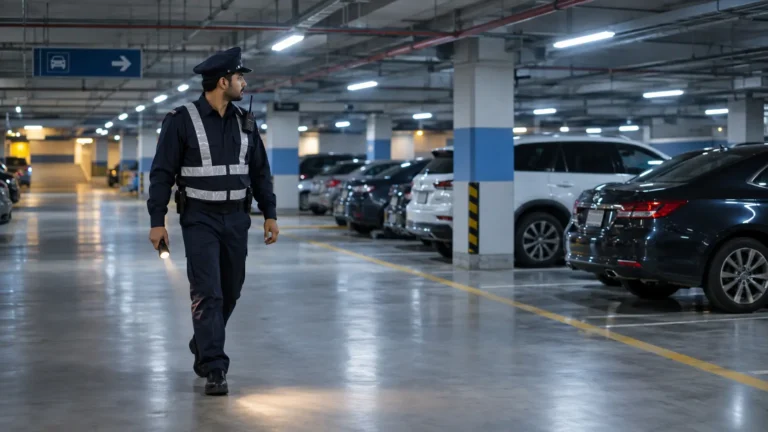
For a corporate office or a retail outlet here, the biggest exposure often is not a break in during business hours. It’s what happens after staff go home and a building sits with nobody watching its entrances, stockrooms or parking basement until the next morning. A restaurant or café on MM Alam Road faces a different problem entirely: valet parking that needs proper management, and a closing routine where cash, stock and the premises itself all need securing at once, often by staff in a hurry to get home themselves.
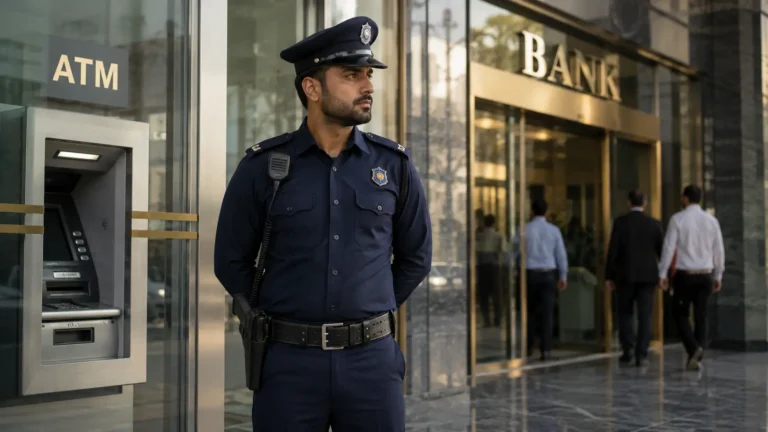
Commercial security deployments in Gulberg typically center on access control for the building itself, whether that is a turnstile and visitor log at a corporate tower or a single supervised entrance for a smaller retail unit, paired with patrols through parking areas and storage zones once the crowds thin out. Office towers with multiple tenants often need a different arrangement again, since guards end up coordinating with several businesses’ schedules under one roof rather than a single client’s routine.
The Walled City and Lahore’s Old Bazaars
Anyone who has walked through the Walled City toward Lahore Fort or Badshahi Mosque knows the streets were not built with vehicles, or modern security planning, in mind. Narrow galis wind between structures that are centuries old in parts, many now repurposed as small workshops, wholesale traders or storage for nearby shops rather than homes. Anarkali, just outside the old city walls, has functioned as a market for so long it is considered one of the oldest in the subcontinent, and Hall Road nearby does the same for electronics.
Security in this part of Lahore looks almost nothing like a DHA deployment. Vehicles cannot reach most of these lanes, so guards work on foot, which changes patrol routes and response times completely. The sheer density of old wiring, packed storage and narrow exits also makes fire awareness as much a part of the job as theft prevention; a guard trained only to watch for intruders is missing half the risk in a market like this. Shops here also tend to empty out completely once shutters come down for the night, leaving stock sitting unattended in a way that rarely happens on a residential street where somebody is usually home.
A guard working the old city or a market street needs local familiarity as much as training: knowing which lanes actually connect to a main road and which dead end, and recognizing which faces belong to the neighborhood and which do not.
Kot Lakhpat, Sundar and the Industrial Belt
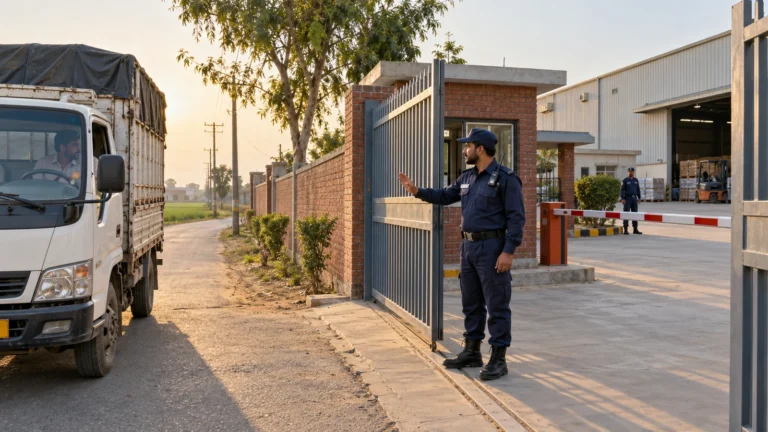
Lahore’s industrial estates sit in an entirely different category again. Kot Lakhpat, laid out in 1960 as one of Punjab’s earliest planned industrial zones, now functions as much as a residential and commercial neighborhood as a manufacturing one, its tight lanes and shared walls calling for tight access control above almost anything else. Sundar, out on Raiwind Road and more than three times the size, poses the opposite problem: long, exposed boundary walls and wide gaps between operating units that a fixed gate guard alone cannot cover.
We have gone into detail on what separates these two estates, along with the smaller industrial pockets around Multan Road and Sheikhupura Road, in our guide to securing industrial estates in Lahore. The short version: a plan built for one rarely transfers cleanly to the other, and treating every industrial plot in the city the same way is usually where losses start.
Getting the Deployment Right for Your Part of Lahore
None of the above is meant to box every property into a fixed category. A single client might own a retail outlet in Gulberg, a warehouse in Sundar and a family home in DHA, three completely different plans under one relationship. What stays consistent is the process. A site visit comes first, walking the actual property rather than a generic version of the neighborhood, to map gates, blind spots and boundary walls before deciding on guard count, shift patterns, or whether the deployment calls for armed or unarmed personnel.
Guards deployed to any part of the city go through background verification and proper training before their first shift, and every guard should be licensed under Punjab’s private security regulations, something worth confirming with any provider before signing a contract, not just ours. Field supervisors then make regular, often unannounced visits to check that post orders are being followed, rather than treating a signed agreement as the end of the relationship. A provider who cannot explain how often they check in on a posted guard is not one worth trusting with a property, wherever in Lahore it happens to sit.
Frequently Asked Questions
Do you provide security guards in every area of Lahore, including newer housing societies?
Yes. Alongside established areas like DHA, Bahria Town, Gulberg and Model Town, we also deploy to newer developments still under construction, where an unfinished perimeter and inconsistent lighting often call for a different patrol pattern than a fully developed society would need.
Is the guard deployment really different for a house versus an office or a shop?
It is. A residential deployment usually centers on gate management, visitor verification and staff checks. A commercial deployment leans more on access control during business hours and coverage once a building empties out at night. A market stall or small shop often needs something closer to a shared patrol covering several units at once rather than a single dedicated guard.
Are armed guards available in every part of Lahore, or only certain areas?
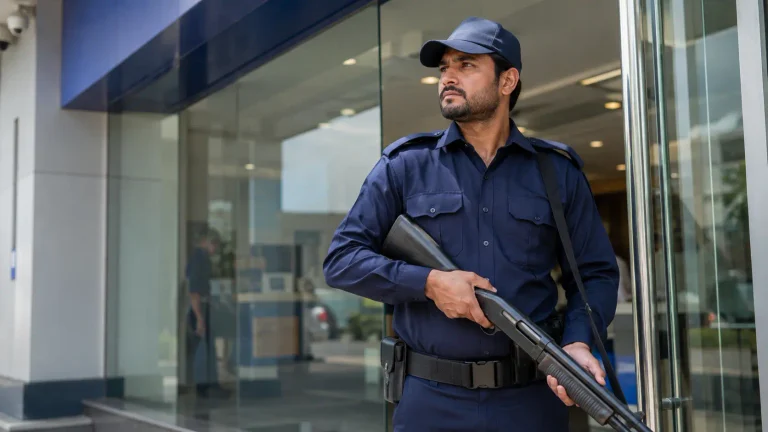
Armed guards can be deployed anywhere in the city, but whether one is actually necessary depends on what is being protected and the specific exposure of that property, not simply which neighborhood it sits in. A jewelry shop in a quiet residential pocket can carry more risk than a low value warehouse in a busier commercial strip.
Can your guards coordinate with a housing society’s own security staff, like DHA’s or Bahria’s?
Yes. Our personnel are briefed to work alongside a society’s existing gate and patrol staff rather than duplicate or interfere with it. The two layers, community wide coverage and an individually assigned guard, are meant to complement each other, not compete.
How quickly can guards be deployed to a specific area of Lahore?
Most deployments, wherever in the city they are needed, are completed within 24 to 72 hours of the initial site visit. Urgent situations, an upcoming event or a family traveling on short notice, can often be prioritized faster.
What determines the cost of security guard services in different parts of Lahore?
Guard type, shift length and whether coverage runs 24/7 affect pricing more than location alone does. That said, properties with longer perimeters, like a large DHA plot or an industrial unit in Sundar, typically need more personnel to cover properly than a smaller residential or retail property in a denser area, and that does factor into the final quote.
Get a Security Plan Built for Your Property
A guard standing at a gate means little if the plan behind him doesn’t fit how that particular street, market or plot actually works. Whether you’re protecting a family home in DHA, a shop near Anarkali, or a warehouse out on Raiwind Road, Clutch Security Services builds the deployment around your property instead of handing over a standard package.
Get in touch through our contact page to arrange a free site assessment, and we’ll walk you through exactly what your part of Lahore needs.