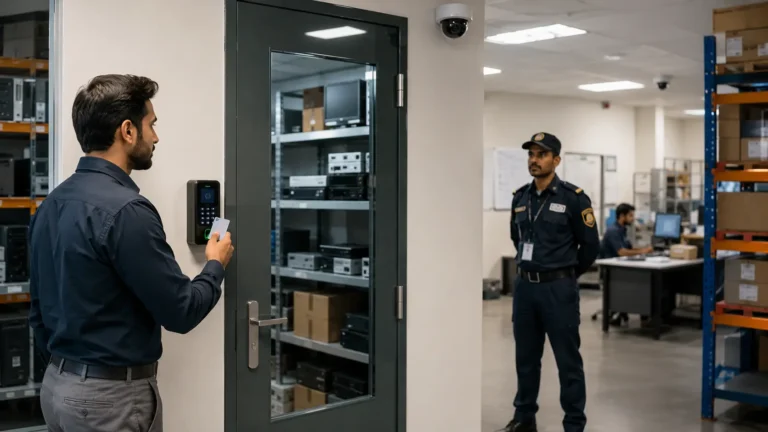
In House Guards vs Hiring a Security Company: Which One Really Saves You Money?
Every business owner comparing security options runs into the same question sooner or later: is it cheaper to hire guards directly, or to bring in a professional security company? On paper, building your own team looks like the budget friendly choice. You set the salary, you skip the agency markup, and you are the one calling the shots. Once you factor in everything that sits underneath that monthly wage, though, the math often tells a different story.
If you manage a warehouse in Faisalabad, an office in Lahore, or a residential society in Gujranwala, this decision affects more than just your monthly budget. It shapes how well your property is protected, how quickly you can replace a guard who quits, and how much liability lands on your desk if something goes wrong. This guide breaks down the real numbers so you can make the call with your eyes open.
The Short Answer
For most businesses, an outsourced security company works out cheaper once you count recruitment, training, licensing, supervision, insurance, and staff turnover. In house teams can pencil out for very large sites with a stable, long term headcount and a dedicated HR department already in place. Everyone else usually pays more to do it themselves, they just do not see the cost on one clean invoice.
What In House Guards Actually Cost You
Hiring guards directly feels straightforward at first. You post a job, interview a few candidates, and agree on a salary. The trouble is that the salary is only the starting point.
- Recruitment and screening. Sourcing candidates, running interviews, and verifying references takes real time, and a bad hire means starting the process again.
- Training. Guards need briefing on post orders, access control procedures, emergency response, and site specific rules. Someone on your payroll has to design and deliver that training.
- Licensing and documentation. Armed guards require weapons licenses and proper registration. Keeping this paperwork current is an ongoing administrative job, not a one time task.
- EOBI and social security contributions. As an employer, you are responsible for statutory contributions, not just the base wage.
- Uniforms and equipment. Uniforms, torches, communication radios, and patrol logs all need to be bought and replaced.
- Overtime and shift gaps. Sick days, holidays, and no shows leave posts uncovered unless you maintain spare staff, and spare staff sit on your payroll even when they are not deployed.
- Supervision. Someone has to check that guards are actually at their posts, awake, and following procedure. That supervisory role is another salary.
- Turnover. Security staff turnover tends to run high across the industry. Every departure means repeating recruitment and retraining from scratch.
None of these show up as a single line item on day one. They arrive gradually, and most business owners only notice the full weight of them at the end of the year.
What You Are Really Paying For With a Security Company
A security company’s quote can look higher than an in house guard’s salary at first glance. That figure usually bundles in everything listed above, plus a few things an individual employer cannot easily replicate.
- Pre-vetted, trained personnel. Guards arrive already screened, trained, and briefed on standard procedures, so you are not building a training program from zero.
- Built-in backup. If a guard calls in sick or resigns, a reputable provider fills the post the same day, so you are never left without coverage.
- Supervision included. Field supervisors visit sites, check performance, and handle disciplinary issues, which removes that management burden from your team.
- Licensing handled for you. The company maintains its own registration, weapons licensing, and compliance paperwork.
- Liability coverage. If a guard is negligent or an incident occurs, a professional provider typically carries insurance that protects your business.
- Scalability. Need extra guards for a wedding, a product launch, or a temporary site? A provider can flex staffing up or down without you hiring and firing directly.
You are not just buying manpower. You are buying a system that keeps that manpower reliable, accountable, and replaceable on short notice.
Side by Side Cost Comparison
| Cost Factor | In House Guards | Outsourced Security Company |
|---|---|---|
| Recruitment and screening | Your responsibility, ongoing | Handled by the provider |
| Training | You design and pay for it | Included in the service |
| Licensing (armed guards) | You manage renewals | Provider maintains it |
| EOBI and statutory contributions | You pay as employer | Covered within provider’s cost |
| Uniforms and equipment | You purchase and replace | Usually included |
| Coverage during absences | You need spare staff on payroll | Provider supplies a replacement |
| Supervision | Needs a dedicated manager | Field supervisors included |
| Liability if something goes wrong | Falls on your business directly | Often covered by provider insurance |
| Flexibility for short term needs | Difficult, hiring takes weeks | Guards can be added or reduced quickly |
| Predictability of monthly spend | Variable, depends on turnover and incidents | Fixed, agreed in the contract |
Hidden Expenses Most Business Owners Forget
A few costs rarely make it into the initial comparison, and they are the ones that quietly erode any savings from going in house.
Management time. Someone on your team now spends part of their week managing guards instead of running the business. That time has a cost even if it does not appear on an invoice.
Replacement gaps. When an in house guard resigns without notice, the post can sit uncovered for days while you scramble to find a replacement. That gap is exactly when incidents tend to happen.
Legal exposure. If an in house guard mishandles a situation, whether it is excessive force, negligence, or a procedural error, your business carries the liability. A contracted security company usually absorbs a portion of that risk through its own insurance and vetting standards.
Equipment maintenance. Radios break, torches die, and uniforms wear out. Someone has to track and replace this equipment continuously.
When In House Security Might Make Sense
Outsourcing is not automatically the right answer for every situation. In house guards can work well when:
- You run one very large facility with a stable, predictable headcount over many years
- You already have HR and compliance staff who can absorb recruitment and licensing without added strain
- Your security needs are highly specialized and unlikely to change
- You have the scale to negotiate group insurance and statutory contributions efficiently
Even in these cases, many businesses still choose a hybrid approach, keeping a small in house team for daily operations while contracting a provider for overflow, events, or specialized armed protection.
When Outsourcing Wins on Cost
For most commercial properties, factories, retail locations, and residential communities, the maths tends to favor an outsourced provider, particularly when you factor in:
- Fluctuating staffing needs across seasons or events
- Multiple sites across different cities such as Lahore, Faisalabad, Sialkot, Gujranwala, or Kasur
- Limited internal HR capacity to manage recruitment and compliance
- A preference for one predictable monthly cost instead of variable, hard to forecast expenses
How to Work Out Your Real Number
Before deciding, add up the full picture rather than comparing a guard’s salary against a company’s quote. For an in house team, total the wage, statutory contributions, uniforms, training, supervision salary, spare staff for coverage, and an estimate for turnover related costs. For an outsourced provider, request a detailed quote that specifies exactly what is included, then confirm there are no hidden add ons for supervision or replacement guards.
Once both numbers are on the same page, the comparison usually gets a lot clearer.
A Quick Example
Picture a mid sized warehouse in Faisalabad that needs two unarmed guards covering a 24 hour rotation, seven days a week. Running this in house means hiring at least four to five guards to cover shifts, holidays, and sick leave, plus a supervisor to check on them, plus uniforms and radios, plus the HR time to keep everyone properly documented. Outsourcing the same coverage to a security company folds all of that into one contract, with a replacement guard available the same day if someone is unwell. For a business without an existing HR department built for this, the outsourced route is usually both cheaper and far less stressful to manage.
Frequently Asked Questions
Is hiring a security company always more expensive than in house guards?
Not on paper, but once you add training, licensing, supervision, coverage for absences, and liability, an outsourced provider is often the more cost effective option for most businesses.
Can I mix in house staff with an outsourced security company?
Yes. Many businesses keep a small internal team for daily routine tasks and bring in a professional provider for armed guards, event coverage, or temporary overflow.
What should I check before signing with a security company?
Verify their business registration, ask for evidence of guard training and background checks, confirm supervision and replacement policies, and get a written breakdown of exactly what the quoted price includes.
Do security companies provide armed guards too?
Reputable providers offer both armed and unarmed options, matched to your risk profile, whether that is a corporate office, a bank, a factory, or a high value warehouse.
Final Verdict
There is no universal right answer, but for the vast majority of businesses across Pakistan, an outsourced security company delivers more predictable costs, faster coverage during absences, and less administrative weight on your team, once every hidden expense of an in house team is accounted for. In house staffing can still make sense at a large enough scale with dedicated management already in place, but it rarely beats a well run provider on total cost once you look past the base salary.
If you are weighing this decision for your own property, whether it is an office, a warehouse, a residential community, or an event, Clutch Security Services can walk you through a real cost comparison based on your specific site and risk profile.
Get in touch with our team for a free site assessment and a transparent quote.