Why Banks and Cash-Handling Businesses in Pakistan Can’t Skimp on Armed Guards
In late 2024, a security guard in Islamabad’s G-9 sector was shot and critically wounded while carrying cash from a delivery van into a bank branch. The attackers — two men on a motorcycle, one carrying a Kalashnikov — were gone in under a minute, over Rs. 850,000 richer. Police records from that same week show it wasn’t an isolated incident; the capital saw several armed attempts on banks and cash vans within a matter of days.
That’s the operating reality for any business in Pakistan that holds, moves, or hands out large sums of cash — banks, exchange companies, cash-in-transit operators, jewellers, and high-volume retailers included. The guard standing between that cash and a criminal can’t be an afterthought. Here’s why armed guards need to be licensed, trained, and properly supervised — not just present — and what that actually takes to get right.
Cash Still Draws Criminals in Pakistan
Every bank branch, ATM, cash office, and cash-in-transit van in the country is effectively advertising that money is close by. Criminals don’t need inside information to work that out — they only need to watch a routine for a few days.
Consider the Rs. 300 million cash-in-transit robbery in Karachi in 2026. The crew stopped for tea on the way to deliver cash to a private bank, and by the time they’d finished, four men had taken control of the vehicle. There was no shootout and no forced entry — the robbers weren’t even armed. A later investigation found the crew’s own security in-charge had colluded with them, while the guards on duty had left the van unattended with its doors open.
Two very different incidents, one shared lesson: cash-handling businesses across Lahore, Karachi, Islamabad, and other major cities are targeted constantly, and the ones hit hardest are usually the ones where guarding had quietly become a checkbox instead of a system.
What State Bank of Pakistan and the Pakistan Banks Association Expect
This isn’t only a risk-management question — it’s built into how Pakistan regulates its banking sector. The State Bank of Pakistan (SBP) requires every bank and financial institution under its supervision to run a formal security program suited to its branches and operations, and it has handed the job of vetting who’s allowed to guard that industry to the Pakistan Banks’ Association (PBA).
Since 2007, the PBA has maintained a Panel of Approved Security Agencies. Under SBP’s framework, banks and financial institutions are only permitted to source branch guards and cash-in-transit crews from agencies on that panel, and those agencies are contractually required to verify the CNIC, employment history, and background of every guard and supervisor placed inside the banking sector — guards with doubtful or defective credentials have to be removed from banking assignments altogether. The PBA also publishes recommended minimum security standards covering how bank branches and offices should be staffed and equipped.
The consequences of skipping this aren’t hypothetical. In 2023, investigators looking into a Rs. 8.7 million robbery at a Karachi bank found the branch hadn’t followed the State Bank’s standard operating procedures for security — a finding serious enough that both the city’s police chief and the interim home minister publicly questioned why. For a bank, choosing security on price alone isn’t just a safety gap; it can be a compliance gap too.
Not All Guards Are Equal: Why “Armed” Has to Mean Trained and Supervised
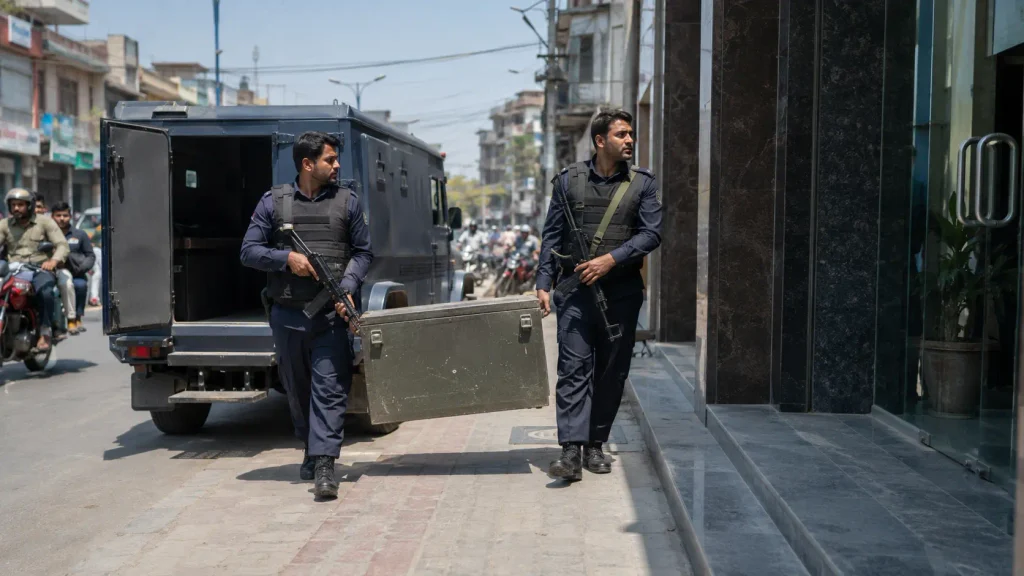
Here’s the uncomfortable part of that Karachi Rs. 300 million case: the robbers didn’t need weapons. The failure wasn’t a lack of firepower — it was a lack of vetting, discipline, and supervision. A guard force, armed or not, is only as dependable as the people wearing the uniform and the systems checking on them.
That’s the real case for professional armed security, as opposed to simply “guards with guns.” Done properly, it looks like:
- Guards who are licensed and background-checked before deployment, not handed a firearm on day one
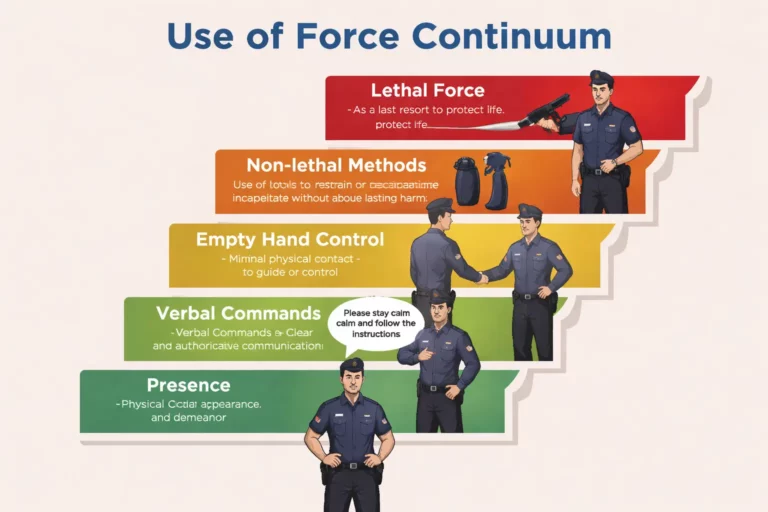
- Training in threat assessment, situational awareness, and lawful use of force, so a guard’s instinct during a hold-up is controlled response, not panic
- Clearly defined rules of engagement, so every guard knows exactly when and how they’re authorized to act
- Active supervision — field visits, patrol verification, and a command structure that catches problems long before they become a nine-figure headline
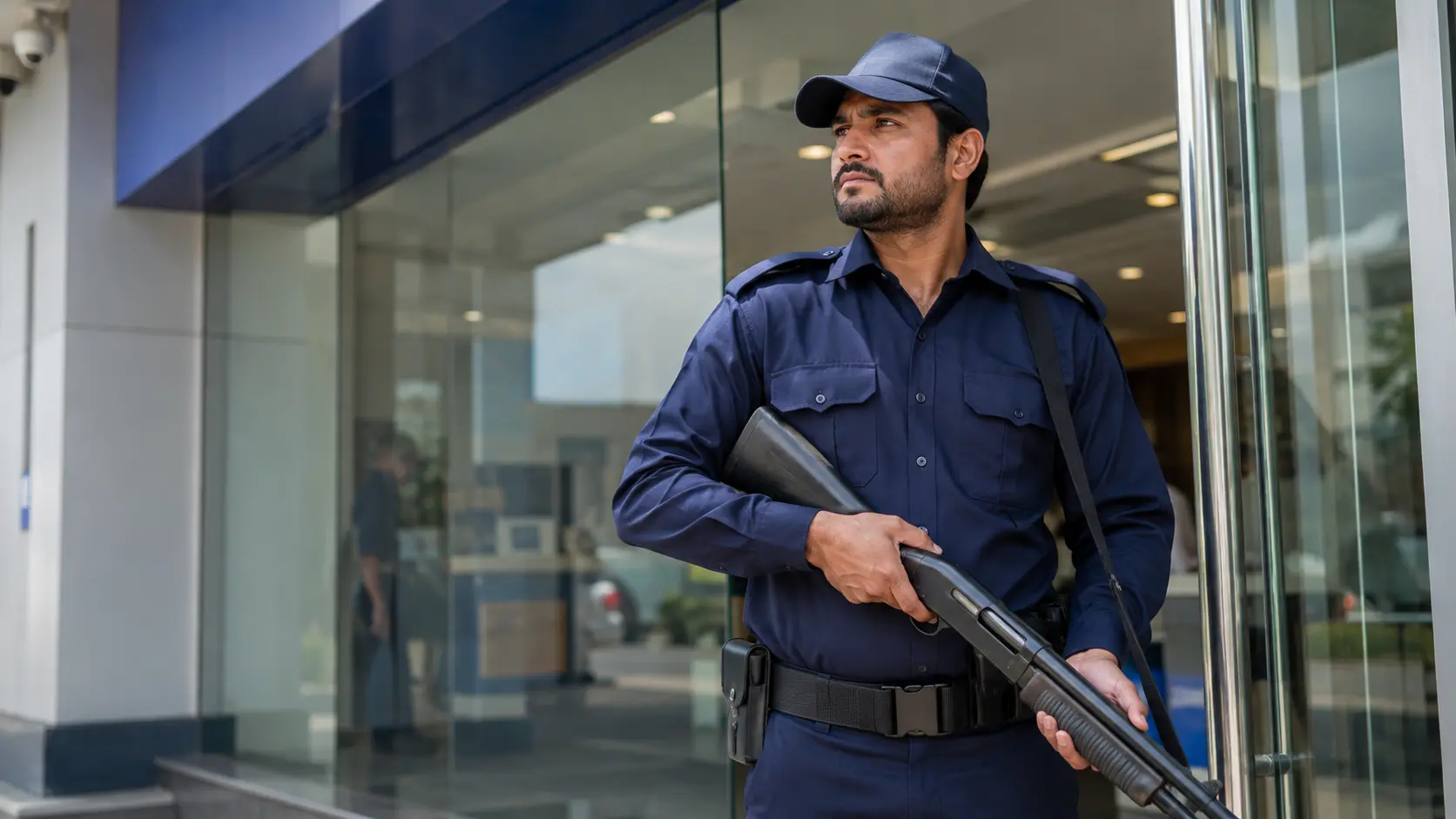
A visible, competent armed guard also changes the calculation before anything happens. Most cash crime in Pakistan is opportunistic or lightly planned, and it targets the path of least resistance. Close that opening, and a large share of these incidents simply don’t happen in the first place.
The Real Cost of Cutting Corners on Security
A cheaper guard contract looks like a saving right up until something happens — and then it usually isn’t one. A single cash-in-transit loss, like the Karachi case above, can erase years of “savings” from an underpriced security contract in a single afternoon. The direct loss is only part of the bill:
- Liability exposure: if an employee or customer is hurt during an incident and the business can be shown to have under-resourced its security, that’s an opening for negligence claims.
- Regulatory risk: for banks specifically, using an unlisted or unverified security agency risks falling outside SBP and PBA requirements — a compliance problem layered on top of a security one.
- Reputational damage: robbery footage moves fast on Pakistani news channels and social media, and customers notice which banks and businesses seem to have security under control.
- Operational disruption: after an incident, expect a closed branch, shaken staff, higher turnover, and a harder time recruiting for cash-handling roles.
- Insurance friction: insurers examine security arrangements closely after a claim, and weak guarding can affect both payouts and future premiums.
None of this means every business needs a small army of guards. It means the guards on payroll need to be the right ones: armed where the risk calls for it, and licensed, trained, and supervised in every case.
What to Look for When Hiring Armed Guards for Your Bank or Cash Business
Before signing with any provider, banks, exchange companies, and cash-handling businesses should be able to get straight answers to a short list of questions:
- Licensing and registration: Is the company properly registered, and — for bank contracts — positioned to meet SBP/PBA sourcing requirements?
- Guard vetting: Are CNIC checks, employment history, and background verification carried out for every guard, not only supervisors?
- Firearms training: What does use-of-force and threat-response training actually cover, and how often is it refreshed?
- Supervision: Are there field supervisors running random site checks, backed by a control room that can respond to an incident in real time?
- Site assessment: Does the provider start with an actual risk assessment of the branch, cash office, or transit route — or just quote a headcount and a rate?
- Deployment and backup: How fast can guards be deployed, and is there a bench of backup personnel if someone falls sick or leaves mid-contract?
- Contract clarity: Are service levels, reporting, liability coverage, and pricing spelled out in writing, with no vague clauses?
A provider that can’t answer these clearly is a provider that’s asking your business to gamble with its cash, and its reputation.
Don’t Wait for a Headline to Test Your Security
Every incident above started the same way: a business assumed its existing setup was probably fine. Clutch Security Services works with banks, cash offices, and cash-in-transit operations across Lahore, Gujranwala, Faisalabad, Sialkot, and Kasur to make sure that assumption is never tested. Every deployment starts with a proper site risk assessment, uses licensed and background-checked armed guards, and is backed by round-the-clock supervision — with standard deployment in 24 to 72 hours and faster turnaround for urgent needs.