
Securing Industrial Estates in Lahore: Kot Lakhpat, Sundar and Beyond
Drive through Kot Lakhpat on a weekday afternoon and mopeds outnumber the trucks. Workshops sit shoulder to shoulder with tea stalls and a mosque, and one factory’s boundary wall often doubles as the back wall of a house next door. Head out to Sundar on Raiwind Road instead, and the picture flips completely. Long stretches of empty boundary wall, plots still waiting for construction, and wide gaps between one running unit and the next, sometimes with nobody in sight for several hundred meters.
Both are industrial estates, and both sit inside the same city limits. What they need from a security standpoint is not the same at all. A guard deployment built for Kot Lakhpat’s tight lanes can fall apart the moment it’s copied onto Sundar’s open stretches, and a plan sized for Sundar would be wasted on a compact plot squeezed between two neighbors back in Kot Lakhpat. Getting this right starts with understanding that difference, not treating every industrial plot in Lahore the same way.
Clutch Security Services works with factory owners, warehouse managers and plot holders across Lahore’s industrial belt, and this piece looks at what genuinely separates Kot Lakhpat and Sundar from a security standpoint, along with the smaller pockets that sit outside both.
Why One City’s Industrial Estates Don’t Share One Risk Profile
Lahore grew around its industry rather than the other way round. Kot Lakhpat, officially the Quaid-e-Azam Industrial Estate, was laid out in 1960 as a joint development program between Pakistan and Canada, making it one of the oldest planned industrial zones in Punjab. More than six decades later, the city has closed in around it from every side. Defence Housing Authority sits to its east and Township to its west, and what began as a purpose built industrial park now functions as much as a residential and commercial neighborhood as it does a manufacturing hub.
Sundar Industrial Estate tells a different story. Spread across roughly 1,767 acres of Raiwind Road, it was developed by the Punjab Industrial Estates Development and Management Company (PIEDMC) specifically to pull heavy industry away from the congestion that had built up around older estates like Kot Lakhpat. That’s more than three times Kot Lakhpat’s original 565 acres, and it shows in everything from road widths to how far apart individual units sit.
Neither estate is inherently safer than the other. They simply fail in different ways when security gets treated as an afterthought.
Kot Lakhpat: An Old Industrial Core Inside a Growing City
Anyone who has spent time hunting for a specific plot number in Kot Lakhpat knows the estate was never built with today’s traffic and density in mind. Narrow internal roads, shared walls between adjoining units, and a mix of factories, godowns, small offices and residential plots packed into the same blocks all create a particular set of problems.
Multiple informal access points. Beyond the main gates, decades of piecemeal development have left back lanes, shared alleys and gaps between properties that someone determined enough can use to get in without ever passing a checkpoint.
Heavy foot and vehicle traffic. Because Kot Lakhpat functions as part residential neighborhood, part commercial strip and part industrial zone, telling a genuine visitor apart from someone casing a property takes real training rather than a passing glance.
Older infrastructure. Boundary walls, gates and lighting in parts of the estate date back decades, and gaps that would never survive a modern site assessment are the norm in more than a few blocks.
Proximity to Kot Lakhpat Jail and the railway station brings its own mix of pedestrian and vehicle movement through the area at most hours, another layer a guard team needs to read correctly instead of tuning out.
For a plot owner here, the priority usually isn’t a sprawling perimeter patrol. It’s tight access control at every possible entry point, guards who know the neighborhood well enough to spot what doesn’t belong, and coverage that accounts for a property being watched from three sides by neighbors who pose no threat themselves, yet aren’t part of the security plan either.
Sundar Industrial Estate: Scale, Distance and a Different Kind of Exposure
Sundar sits far enough out on Raiwind Road that the character of the place changes the moment you turn in. Bigger plots, wider internal roads and far more distance between one operating unit and its neighbor mean the estate runs into problems that rarely show up in a dense area like Kot Lakhpat.
Long, exposed boundary walls. A single unit here can carry several hundred feet of perimeter wall running along a quiet stretch of road, which is a lot more wall for a guard to actually watch than anything found in an older, tightly packed estate.
Vacant and under construction plots nearby. With the estate still filling out, an operating factory can sit right next to an empty plot or a half built shed, giving anyone with bad intentions somewhere to watch from, or hide in, without drawing attention.
Distance from the city center. Response time matters everywhere, but a call for help from deep inside Sundar takes longer to answer than one from a plot a few minutes off Ferozepur Road. That gap has to be closed by the guard team on site, not assumed away.
Fewer eyes around after dark. Kot Lakhpat’s crowding works in an owner’s favor at night, since there’s almost always somebody nearby. Sundar’s spread out layout means a stretch of wall can go unwatched for long periods once the day shift clears out.
Here, the priority flips. Perimeter patrols matter more than gate by gate checks alone, and a guard team needs enough people and mobility, on foot or by bike, to cover ground rather than stand fixed at a single post all shift.
Industrial Pockets Beyond These Two
Kot Lakhpat and Sundar are the two named, formally managed estates, but plenty of Lahore’s industrial activity sits outside both. The Multan Road belt, stretching from Thokar Niaz Baig out toward Raiwind, carries a dense mix of engineering workshops, auto parts manufacturers and smaller production units, many running without the planned infrastructure Kot Lakhpat or Sundar were built with. Further along, Sheikhupura Road carries its share of heavy engineering and steel processing plants, while pockets around GT Road and Shahdara handle light engineering and cycle parts manufacturing, an industry Lahore has produced for generations.
None of these areas were designed with security in mind the way a PIEDMC managed estate was. That usually means the basics, a proper boundary wall, a controlled gate, and a guard who’s actually trained rather than just present, matter even more than they do inside Kot Lakhpat or Sundar.
Where Industrial Estates Lose Money
Whatever the estate, losses rarely trace back to one dramatic break in. They build up from smaller gaps nobody closed in time.
Gate checks that exist on paper only. A logbook sitting untouched at the security desk isn’t access control, it’s decoration. Every vehicle and every visitor needs real verification against who they say they are and why they’re there.
Loading and dispatch. This is where staff and outside transport meet, and where a driver who knows the loader well can quietly move more out the gate than what’s written on the delivery slip.
Contractor and daily wage labor movement. Most units bring in outside labor for loading, maintenance or short jobs, and without a system for logging who’s on site and why, that flow becomes hard to track.
Night shifts and holidays. Fewer people on site almost always means fewer eyes watching, and that’s when opportunistic theft tends to happen, not on a busy Tuesday afternoon.
Unsecured storage and open yards. Raw material or finished goods sitting in an open yard without dedicated coverage is an easy target, especially in an estate like Sundar where a yard might not even be visible from the road.
What a Working Industrial Security Plan Actually Covers
A guard posted at the gate is a start, not a plan. A properly run deployment covers several things at once, whatever estate the property sits in.
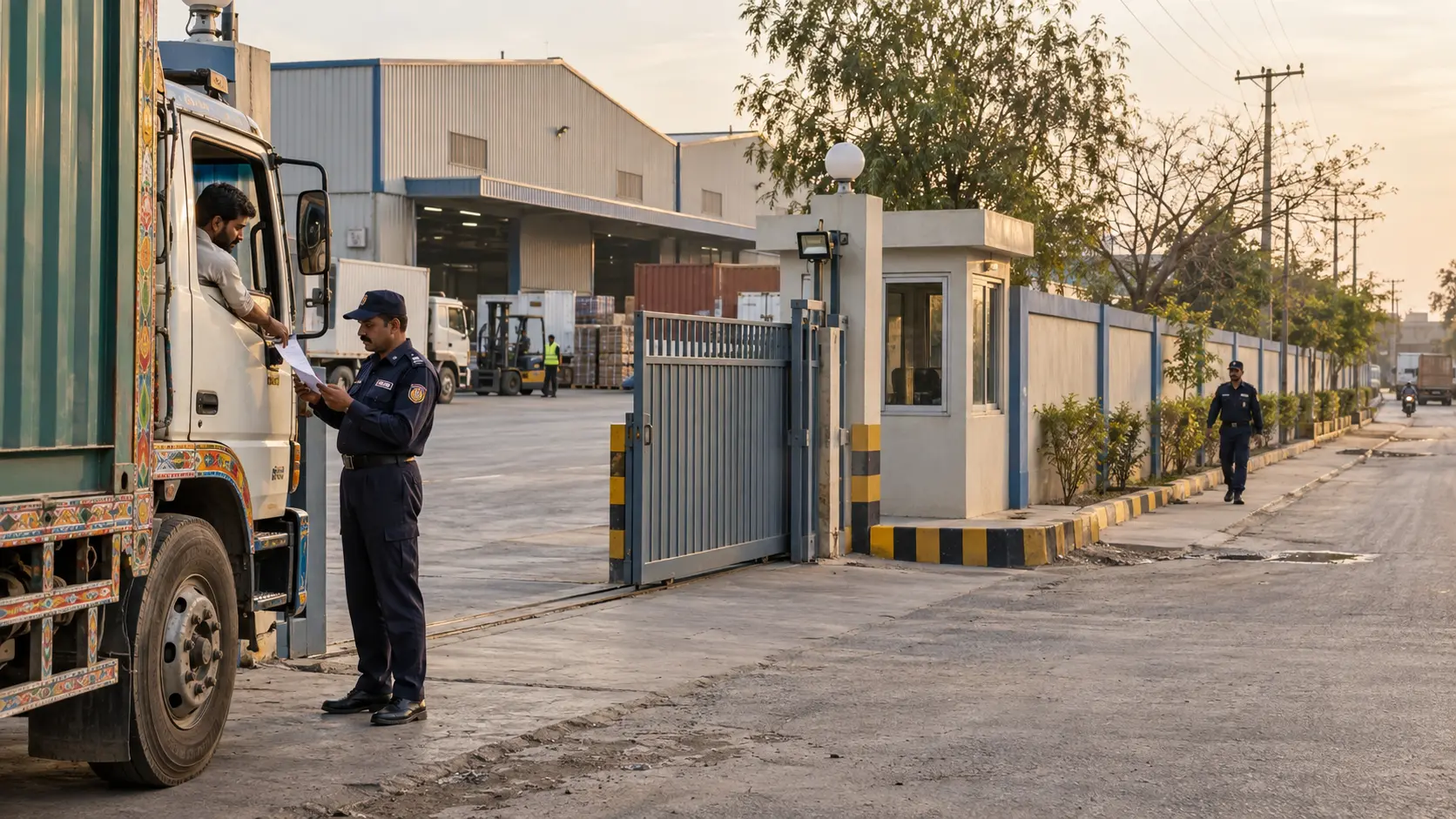
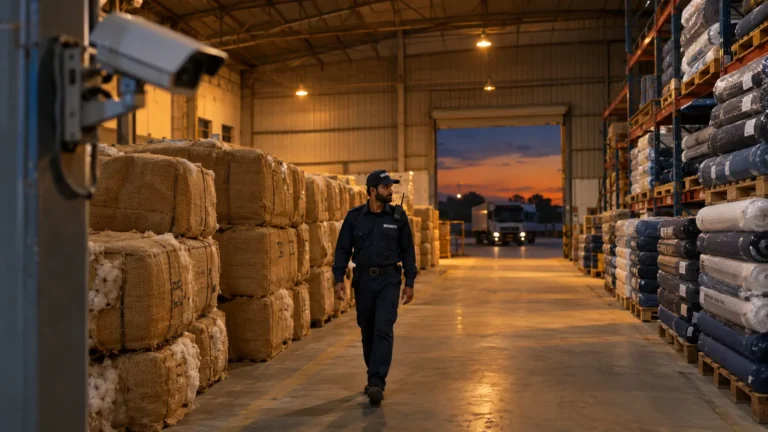
A site assessment comes first, walking the property to map every gate, wall, blind spot and storage point before deciding how many guards go where and on what schedule. Gate and vehicle control follows, checking every truck, car and visitor against a log rather than waving familiar faces through out of habit. Scheduled and random patrols cover the perimeter, loading areas and storage zones, documented through a checkpoint system so there’s a real record of what got checked and when.
For estates like Sundar, mobility matters as much as headcount. Guards covering long stretches of wall need to move, whether on foot rounds or bicycle patrol, rather than stay fixed at one post while the rest of the perimeter goes unwatched for hours. In Kot Lakhpat, the priority sits more with access discipline, since the estate’s tight layout means most incidents start at a gate or a shared boundary rather than a lonely stretch of wall.
Where risk justifies it, armed guards add a level of deterrence unarmed staff can’t match, particularly for units holding cash, raw material or finished stock worth targeting. Lower risk zones of the same property are often well covered by trained unarmed guards handling access control and general patrolling. None of it holds together without supervision, though. Field supervisors need to visit the site in person, confirm guards are where they should be, and step in the moment something looks off, rather than deploying a team and disappearing until the next invoice is due.
How Clutch Security Services Covers Lahore’s Industrial Estates
At Clutch Security Services, an industrial deployment starts the same way regardless of location: a proper site walk before a single guard gets posted. For a Kot Lakhpat plot, that means mapping every informal access point and shared wall on the block. For a unit in Sundar, it means measuring how much perimeter one guard team can realistically cover and building patrol routes around that distance instead of guessing.
Guards go through background verification and proper training before deployment, and field supervisors keep checking in through the week rather than treating a signed contract as the finish line. It’s the same standard applied across our security services in Lahore, adjusted for whichever part of the city a client’s property actually sits in, whether that’s a compact unit off Ferozepur Road or a large plot deep inside Sundar.
Frequently Asked Questions
Do Kot Lakhpat and Sundar need the same number of guards for a similar sized plot?
Not usually. Sundar’s larger, more open layout typically calls for guards positioned for mobility and perimeter coverage, while a similar sized plot in Kot Lakhpat often needs more focus on access points given how tightly packed the surrounding blocks are. A site assessment settles the actual number rather than a flat rule.
Are armed guards necessary for industrial estates in Lahore?
It depends on what’s being stored and the plot’s specific exposure. Units holding cash, valuable raw material or finished stock, or sitting in a more exposed part of an estate, usually justify armed coverage, while lower risk plots are often well served by trained unarmed guards.
Can a small unit in Sundar or Kot Lakhpat get security without a large contract?
Yes. Coverage can be scoped to a single shift, a specific gate, or a defined patrol route depending on budget and risk, and many owners start smaller before expanding once they see the difference proper coverage makes.
How quickly can guards be deployed to an industrial plot?
Standard deployment typically takes 24 to 72 hours once a site assessment is complete, with faster turnaround available for urgent situations.
Protect Your Plot, Wherever It Sits in Lahore’s Industrial Belt
A guard standing at the gate means little if the plan behind him doesn’t match how your particular estate really works. Whether that’s tight access control for a plot in Kot Lakhpat or long perimeter coverage for several hundred feet of wall in Sundar, Clutch Security Services builds the deployment around your property instead of handing over a standard package.
Get in touch through our contact page to arrange a site assessment and find out exactly what your plot needs.





One Comment