Cash in Transit Robberies Are Rising in Pakistan: How Banks and Businesses Stay Protected
Rs300 million disappeared from a private security company’s cash van in Karachi’s Jauharabad area on the morning of June 12, 2026. Investigators later found the heist had inside help, planned with the assistance of a member of the very crew assigned to move the money. It was one of several major cash in transit robberies Pakistan has seen over the past two years, and it points to a pattern that banks, retailers and cash handling businesses can no longer treat as a rare occurrence.
Cash in transit crime has turned into one of the most persistent threats facing Pakistani banks and businesses today. This post looks at what is driving the rise, walks through recent cases that show how these robberies actually happen, and explains the protective measures that separate a secure cash operation from an exposed one.
Why Cash in Transit Crime Is Climbing Across Pakistan
Several forces are pushing the numbers upward at once.
Cash still moves a large part of the Pakistani economy. Despite growing use of digital payments, a significant share of retail, wholesale and banking transactions still settle in physical currency, which means branches, ATMs and businesses regularly need funds collected, counted and transported. Every one of those movements creates a window of exposure.
The private security sector has expanded fast to meet that demand, and growth without matching oversight opens gaps. Reports on major heists, including the Karachi case above, have repeatedly named guards or crew members hired by security companies as the people who tipped off or assisted the robbers. When vetting and supervision lag behind the number of personnel a company puts on the road, insider risk grows right along with it.
Organized gangs have also become more coordinated. Police investigating the Rs300 million Jauharabad robbery described an inter provincial network with members active across Karachi, Islamabad, Rawalpindi, Quetta and Multan, allegedly tied to dozens of earlier bank related robberies. This is not opportunistic street crime. It is planned, resourced and repeated.
Finally, urban traffic and layout work against cash movement. Congested routes, predictable branch timings and limited alternate paths make it easy for anyone watching a pattern to work out where and when a van will be exposed.
Recent Incidents That Reveal the Pattern
Looking at how these robberies actually unfolded shows why standard precautions keep failing.
Karachi, June 2026: An Inside Job
Armed men struck a private security company’s cash van in Jauharabad and made off with Rs300 million. Police later arrested the alleged mastermind and recovered most of the stolen amount, but the investigation also confirmed that a member of the van’s own crew had helped plan the robbery from the inside. The gang behind it was linked to bank related robberies in several major cities over several years.
Peshawar, March 2025: Ignored Procedures
Armed robbers intercepted a Bank of Punjab cash van in the Hashtnagri area and escaped with more than Rs30 million. Police operations officials later said the van had not followed standard operating procedures for cash movement, a detail that kept surfacing once investigators reviewed the route and timing.
Islamabad, August 2024: A Guard Killed Resisting
A cash van carrying Rs30 million was ambushed within Shahzad Town police limits. A security guard was shot and killed while resisting the robbery, and a second guard was injured.
Three different cities, three different years, one recurring theme. Insider involvement, ignored procedures or predictable timing show up in nearly every major case on record. None of these robberies happened because armed guards were unavailable. They happened because a weak link in the process, whether human, procedural or logistical, was there to exploit.
The Hidden Weak Points in Standard Cash Movement
Most cash in transit plans fail at a handful of predictable points.
Unverified or poorly supervised crew members. A single compromised guard, driver or cashier can hand a gang everything it needs, including timing, route and cash volume. A background check done once at hiring means little if there is no supervision afterward.
Fixed routes and schedules. A van that follows the same path at the same time every week becomes easy to study. Anyone watching for a few days can map out the exact window of vulnerability.
No real time tracking or check in protocol. Without GPS monitoring and scheduled check ins, a delay or a deviation from the planned route may not get flagged until it is too late.
Escorts that are undertrained or unarmed for the risk level. Unarmed staff moving high value cash offer little deterrence and even less response capability if a robbery attempt begins.
No independent oversight. When the same small team plans, executes and reports on a cash run with no outside check, both honest mistakes and deliberate manipulation are harder to catch.
How Banks and Businesses Are Strengthening Cash in Transit Security
The organizations avoiding these losses tend to share a similar approach.
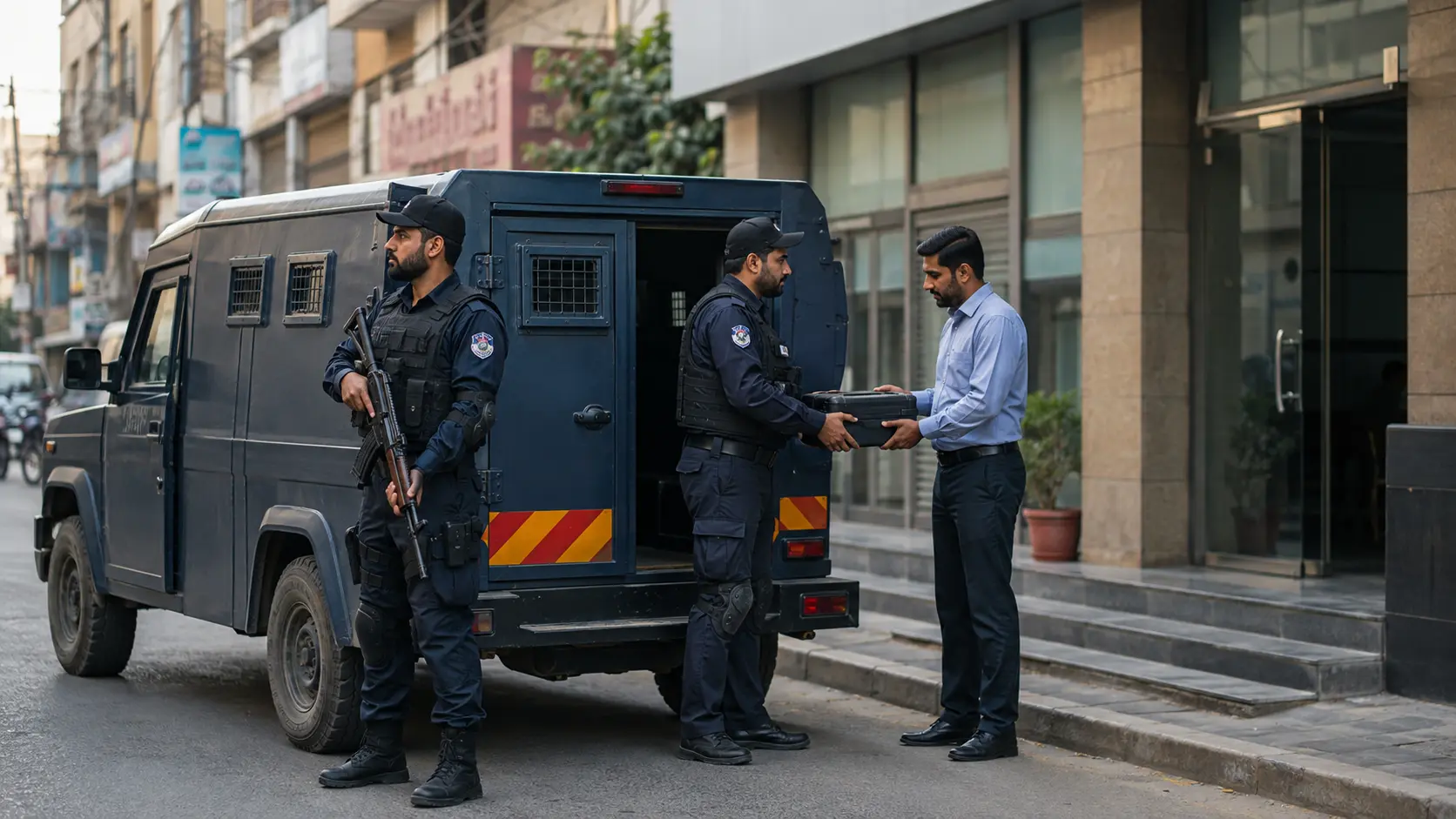
They deploy trained, armed escorts specifically for cash movement, staffed by personnel who go through background verification before deployment and continued supervision after it, not a one time check at hiring.
They vary routes and timing instead of repeating the same pattern, which makes it far harder for anyone conducting surveillance to predict a vulnerable moment.
They track vehicles in real time and require scheduled check ins along the way, so an unplanned stop or detour gets flagged immediately rather than discovered after the fact.
They separate planning from execution. A field supervisor or an outside consultant reviews the route, timing and crew assignment rather than leaving the whole process to the same small team every run, which closes off the exact gap that insider facilitated robberies rely on.
They start with a proper site and route assessment before a single rupee moves, mapping vulnerable points along the journey the same way a professional provider would map entry points at a fixed location. It is the same process Clutch Security Services uses before deploying armed guards for cash handling clients across Lahore, Gujranwala, Faisalabad, Sialkot and Kasur.
What to Look For in a Cash in Transit Security Provider
Not every security company is built for cash movement work, and the difference shows up fast once something goes wrong. Before signing a contract, ask a provider to demonstrate the following.
- Proper business registration and licensing to operate in your city or province
- Documented background checks and training records for every guard assigned to cash duty
- Armed personnel options for high value transfers, along with the licensing that comes with it
- A field supervision system, not just guards reporting on themselves
- GPS tracking and a clear check in protocol built into every route
- Backup personnel available on short notice, so a single absence never leaves a gap
- Clear incident reporting and a 24/7 contact for emergencies
A provider that answers these questions with general reassurance instead of specifics is not one to trust with cash movement.
How Clutch Security Services Protects Cash Movement
At Clutch Security Services, cash handling clients get the same structured process used across our commercial and armed security work. Every engagement starts with a site and route assessment carried out by an experienced consultant, not a generic template. Guards assigned to cash duty go through background verification and deploy as armed or unarmed personnel depending on the risk profile of the transfer. Field supervisors carry out regular checks to confirm procedures are actually being followed, and our operations center stays reachable around the clock for reporting and emergency coordination.
We currently support banks, financial institutions and cash handling businesses across Lahore, Gujranwala, Faisalabad, Sialkot and Kasur, with deployment typically arranged within 24 to 72 hours of a completed assessment.
Protect Your Cash Movement Before It Becomes a Headline
Every case above started out the same way, as a routine cash transfer that someone had already been watching. The gap between a routine transfer and a headline usually comes down to preparation done in advance, not a reaction after the fact.
If your bank, branch or business regularly moves cash across Lahore, Gujranwala, Faisalabad, Sialkot, Kasur or nearby areas, talk to us about a site and route assessment before your next transfer. Contact Clutch Security Services to discuss armed escort options built around your specific risk profile, or reach our team directly on WhatsApp for a faster response.
Frequently Asked Questions
What is cash in transit security?
Cash in transit security refers to the protective measures, usually armed escorts, route planning, tracking and supervision, used while moving cash between locations such as bank branches, ATMs, retail outlets and cash processing centers. It covers the entire window between when cash leaves one secure point and arrives at another.
Why are cash van robberies increasing in Pakistan?
Several factors play a part: continued reliance on physical cash across banking and retail, fast growth in private security staffing without matching oversight, more organized and coordinated criminal networks, and predictable routes or procedures that make surveillance easier for anyone planning a robbery.
How much does cash in transit security cost in Pakistan?
Cost depends on guard type (armed versus unarmed), the number of personnel required, route distance and frequency, and whether the transfer needs extra measures such as GPS tracking or a dedicated supervisor. A reliable provider gives a transparent quotation after assessing your specific route and risk level rather than quoting a flat rate.
How quickly can an armed escort be arranged for cash movement?
Established providers typically deploy within 24 to 72 hours for a standard requirement, once a site and route assessment is complete. Urgent requests can often be accommodated faster if communicated clearly at the outset.
Cash in transit robbery is not going away on its own, and the businesses handling it well are the ones treating it as an ongoing security process rather than a single hire. A properly vetted crew, a varied route, real time tracking and independent supervision will not make headlines, and that is exactly the point.