Auto Parts and Spare Parts Market Security on Bund Road, Lahore
A small carton can hold a surprising amount of money. Sensors, bearings, injectors and other compact components take up little space, but losing a few valuable pieces can eat into a trader’s margin. Unlike a missing engine or a stack of tyres, a missing boxed part may not be noticed until someone needs it for an order.
For auto parts shops, wholesalers and godowns along Bund Road, security needs to follow how goods actually move. Customers collect purchases. Mechanics send helpers. Suppliers drop off cartons. Staff carry stock between the counter and storage. Returns come back through the same doorway as fresh deliveries.
Auto parts market security on Bund Road, Lahore should bring accountability to those movements. A guard’s presence helps, but the real value comes from clear instructions about access, approvals and what happens when something does not match.
Why spare parts need careful security
Many automotive components are portable, valuable and have an active resale market. That combination creates a theft risk even where a business has never experienced a break-in.
Not every item needs the same level of protection. A shop might keep bulky, inexpensive products on open shelving while storing costly electronic components in a controlled cabinet. Used parts can be harder to identify because packaging and manufacturer labels may be missing.
The useful starting point is a short inventory risk review. Which products hold the most value? Which are easy to carry away? Which regularly move between locations? Which have been difficult to reconcile during stock counts?
The answers should shape the security plan. A generic instruction to “watch the shop” leaves too much to interpretation.
Keep customer access separate from stockroom access
A busy counter does not need to become an obstacle course. Customers should be able to ask for a part, inspect an approved sample and collect their purchase without unnecessary delays.
The storage area needs a different rule. Being a regular customer, a familiar mechanic or a supplier’s helper should not automatically give someone permission to walk behind the counter or enter a godown.
A practical arrangement includes:
- A defined area for customers and collections.
- Permission from a named employee before visitors enter storage.
- An access record for contractors, maintenance workers and other occasional visitors.
- A clear handover point where approved goods leave the premises.
Where there are separate front and rear entrances, guard placement should account for both. One person cannot continuously watch the sales counter and a loading door hidden at the back.
For businesses comparing broader coverage options, our security guard services in Lahore explain Clutch’s local security approach.
Match the goods to the dispatch approval
“The owner knows me” is not a dispatch record. Nor is a phone call to someone whose authority has never been confirmed.
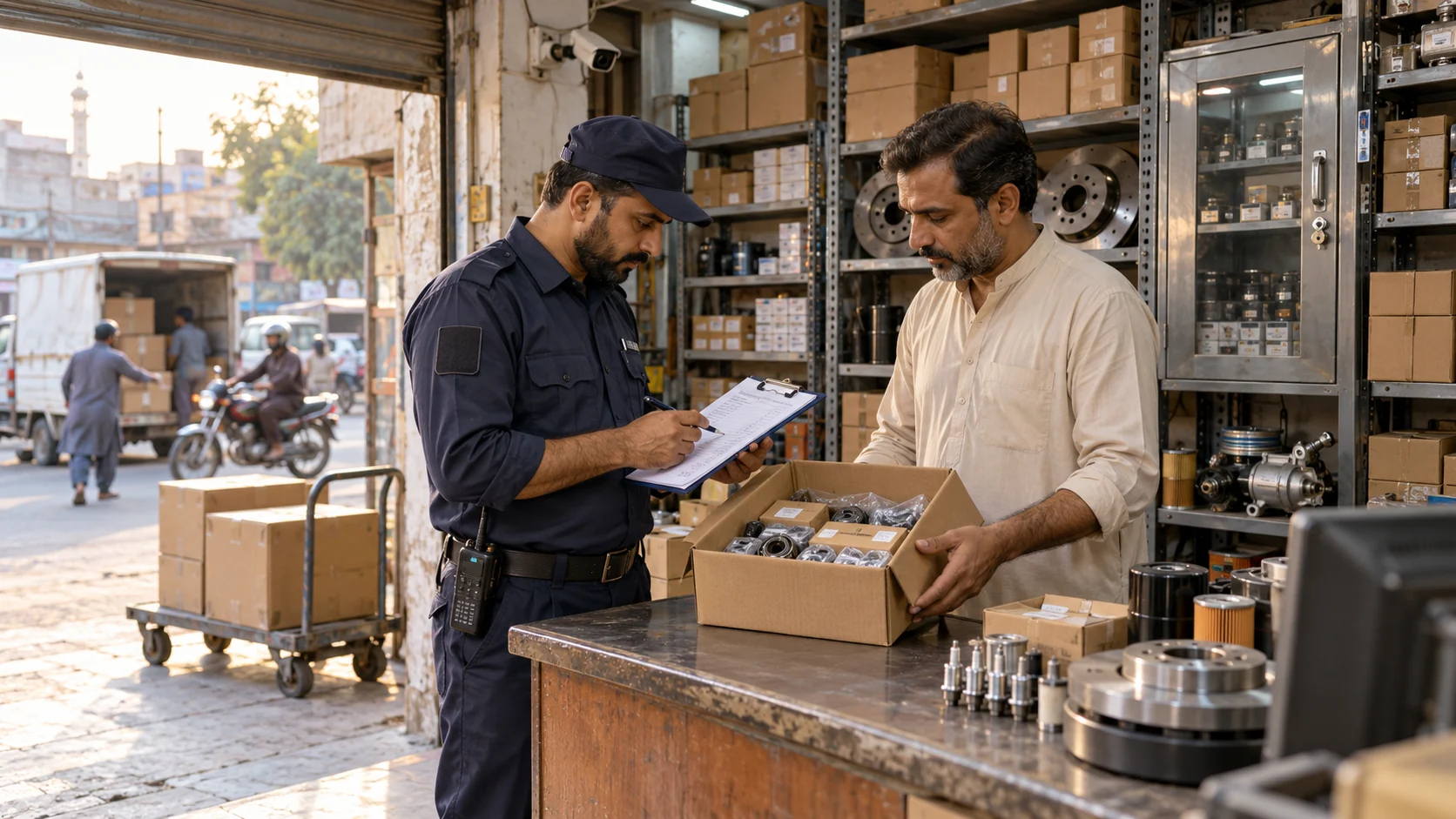
Before goods leave, the person responsible for security should have a clear way to check the collection against an approved document. Depending on the business, that may be an invoice, delivery note or gate pass linked to the sales record.
Useful details include the document reference, item description or part number, quantity, recipient, approving employee and collection time. Vehicle details can be recorded where a delivery vehicle is involved.
Consider a simple example: an approved collection lists six boxed bearings, but eight boxes reach the exit. The guard should pause that collection and contact the nominated manager. Staff can then correct the quantity or issue a properly approved revision.
The guard should not decide which part fits a vehicle, approve credit or change an invoice. Sales and stock staff handle those decisions. Security checks that the release follows the agreed procedure.
Give returns, exchanges and scrap their own records
Spare parts do not always move in a straight line from shelf to buyer. A customer may return an incompatible component. A supplier may collect damaged stock. An old unit may be exchanged against a replacement.
Without separate records, these movements can make genuine stock shortages look like ordinary adjustments.
Record what came in, what went out and who approved the transaction. Where items have serial numbers, use them. For valuable used components without a serial number, photographs or an internal identification reference can help distinguish one unit from another.
Keep returned stock in a designated area until an authorized employee checks it. Packaging alone does not establish that the correct component is inside.
Scrap and discarded cartons also need a release procedure. A guard can verify authorization while stock staff confirm the contents. This keeps disposal accountable without treating every routine collection as suspicious.
Protect movement between the shop and godown
If your sales counter and storage are in separate premises, each transfer needs a record at both ends.
The sending employee records the items and quantities. The receiving employee confirms what arrived. Any difference should be raised promptly, rather than left for the next monthly stock count.
For higher value consignments, numbered seals can support that process. Record the seal when the package leaves and check its condition on arrival. A seal is an additional control; it does not replace counting or verification by the stock team.
Security guards can help verify approved movement at the departure or receiving point. The business should still assign responsibility for the inventory itself to its own staff.
Make CCTV useful at the points where goods change hands
A camera showing the whole shop may miss the detail needed to understand a disputed collection. Camera positioning should consider the entrance, dispatch counter, stockroom doorway and loading area.
Check the actual recordings. Can you see a package being handed over? Does glare from the open shutter hide the doorway? Is the time correct? Does the system keep recording during a power interruption?
Give a named person responsibility for testing recordings and controlling access to footage. When an incident occurs, preserve the relevant period before routine storage overwrite removes it.
CCTV supports security and investigation. It cannot approve a dispatch or respond to a problem by itself.
Use a closing checklist and a proper shift handover
Closing time brings several tasks together: finishing sales, counting cash, moving stock and lowering shutters. A written checklist helps staff avoid leaving an important job to assumption.
Before locking up, confirm that:
- Valuable stock is secured in its assigned storage.
- Pending collections and incomplete dispatches are identified.
- Visitors and collection workers have left.
- Rear doors, windows and shutters are checked.
- Cameras, alarms and required lighting are working.
- Keys are issued or returned through an accountable process.
A night guard should receive a handover covering unresolved issues and any approved after-hours activity. A verbal assurance that “everything is fine” gives the next shift little to work with.
If several traders share an entrance or compound, agree on the patrol area, reporting contact and each shop’s responsibilities in writing. Shared guarding becomes difficult when every owner assumes their own stockroom is included.
How many guards does an auto parts business need?
The answer depends on the layout and workload. A small shop with one controlled entrance has different needs from a warehouse with separate loading access, a rear yard and late deliveries.
Coverage should account for opening hours, collections, breaks, night duties and replacement arrangements. If dispatch activity requires a guard’s full attention, that person may not also be able to patrol a separate storage area effectively.
Armed or unarmed deployment should follow a site risk assessment. Stock value alone does not settle the decision. Access control, supervision, communication and clear duties remain essential whichever option is selected.
Clutch provides armed and unarmed guarding, site assessments and supervised security arrangements. You can explore our wider security services before discussing the requirements of your premises.
What to ask before appointing a security company
Ask the provider to explain how the guard will handle a quantity mismatch, an unapproved collector, a returned component and an after-hours delivery. Those answers reveal whether the plan fits your trade.
The agreed scope should identify guard posts, coverage hours, supervision, absence replacement, incident reporting and the manager authorized to approve exceptions. It should also define the boundary between security duties and stock management.
A guard cannot guarantee that theft will never happen. However, a consistent record of who entered, what left and who approved it makes unexplained movements easier to question and investigate.
Arrange security for your Bund Road premises
Your shop may need help at the collection counter. Your godown may need tighter access control or night coverage. The right arrangement starts with the way your business operates.
Contact Clutch Security Services to discuss security guards for your auto parts shop, spare parts warehouse or godown on Bund Road, Lahore. Share your location, opening hours, entrances and main concerns so the team can assess suitable coverage.
Call: 0300 1267869
Frequently asked questions
Can a security guard check auto parts leaving the shop?
Yes, when dispatch verification is included in the agreed duties. The guard can check the collection against an approved release document and refer discrepancies to the responsible manager. Technical identification and stock approval remain with authorized business staff.
Is a night guard enough for a spare parts godown?
A night guard may help with after-hours coverage, but losses can also occur during deliveries, collections and returns. Review daytime controls alongside night security, locks, lighting and CCTV.
Can neighbouring shops share security guards?
They can consider shared coverage where the layout supports it. The agreement should define entrances, patrol areas, operating hours and reporting responsibilities. A shared guard should not be assumed to provide continuous coverage inside every shop.
What affects the cost of guarding an auto parts business?
Guard numbers, coverage hours, armed or unarmed deployment, site layout and supervision requirements affect the quotation. Provide those details when requesting a price so the proposed service reflects the work involved.