Security Guards for Construction Sites: Why This Job Is Different
A construction site rarely looks the same from one week to the next. Walls that didn’t exist on Monday are half built by Friday. Materials arrive, get used, and get replaced. Crews rotate through, and the layout itself keeps shifting as the project moves from foundation work to framing to finishing touches. For a guard, that constantly moving target changes almost everything about how the job gets done.
Guarding a bank, an office, or a retail store means protecting a fixed space with known entry points and a routine that barely changes day to day. A building site offers no such stability. There’s often no finished perimeter yet, expensive equipment sits out in the open, and dozens of workers, contractors, and delivery vehicles pass through in a single afternoon. Anyone hiring security guards for construction sites needs to understand these differences upfront, because an approach built for a warehouse or office lobby leaves gaps a project site simply can’t afford.
What Sets a Construction Site Apart From Any Other Post
Most static security assignments protect something that already exists, a finished building with walls, doors, and a known number of people who belong inside. A project site is the opposite. It’s being built while it’s being watched, and that creates problems a standard guard post rarely faces.
The property often has no fixed boundary until fencing goes up, and even then, gates and access routes tend to shift as work progresses. Valuable materials such as copper wiring, steel, generators, and power tools sit in open storage rather than locked inside a finished structure. Several contractors and subcontractors move through the same property, frequently reporting to different supervisors, which makes it harder to tell at a glance who’s actually supposed to be there. And the site itself is physically demanding, with excavation pits, moving machinery, and live electrical work all happening near whoever is standing watch.
None of that applies to a typical retail or office assignment. It’s the main reason job site security calls for a distinct kind of guard, and a distinct kind of planning behind them.
The Risks a Construction Site Guard Actually Deals With
01. Theft of Materials and Equipment
Construction materials carry real resale value, which makes them a constant target. Copper wiring, steel pipes, generators, and hand tools go missing often because they’re portable, valuable, and easy to move without drawing attention. In Lahore, a man was recently caught stealing steel and piping from a remodeling project while posing as a laborer, wearing a jacket and cap so he’d blend in with the rest of the crew. Cable theft at the same site had already knocked out nearby streetlights, and stripped barricading sheets left the area more exposed to passersby. It’s a pattern that repeats across active job sites: thieves rarely stand out if no one’s actually checking who belongs there.
02. Unauthorized Access and Trespassing
A property with several crews coming and going, plus deliveries, inspectors, and the occasional curious passerby, is hard to lock down completely. Without someone verifying who’s meant to be on site, outsiders can wander in unnoticed, which raises both theft risk and liability if a person gets hurt where they had no business being.
03. Vandalism and Property Damage
Unfinished structures and idle machinery are easy targets when nobody’s watching. Vandalism doesn’t only cost money to repair, it can push back a project’s timeline and, depending on what’s damaged, create safety issues for the crew returning the next morning.
04. Hazards Guards Have to Navigate, Not Just Watch For
Unlike an office lobby, a job site includes excavation pits, scaffolding, live wiring, and machinery lifting materials overhead. A guard patrolling this kind of environment needs enough hazard awareness to stay safe and to flag conditions that could hurt someone else, which simply isn’t part of a typical retail or corporate assignment.
Day Shift and Night Shift Are Practically Two Different Jobs
On a construction site, what a guard watches for changes completely depending on the hour.
During working hours, the role looks closer to access control than patrol work. Guards check in deliveries, confirm which subcontractors are cleared for that day, manage visitors and the occasional solicitor trying to reach the site engineer, and watch traffic near cranes and heavy vehicles. Most daytime incidents involve someone who shouldn’t be there rather than outright theft, mainly because too many people are around for anything to go unnoticed easily.
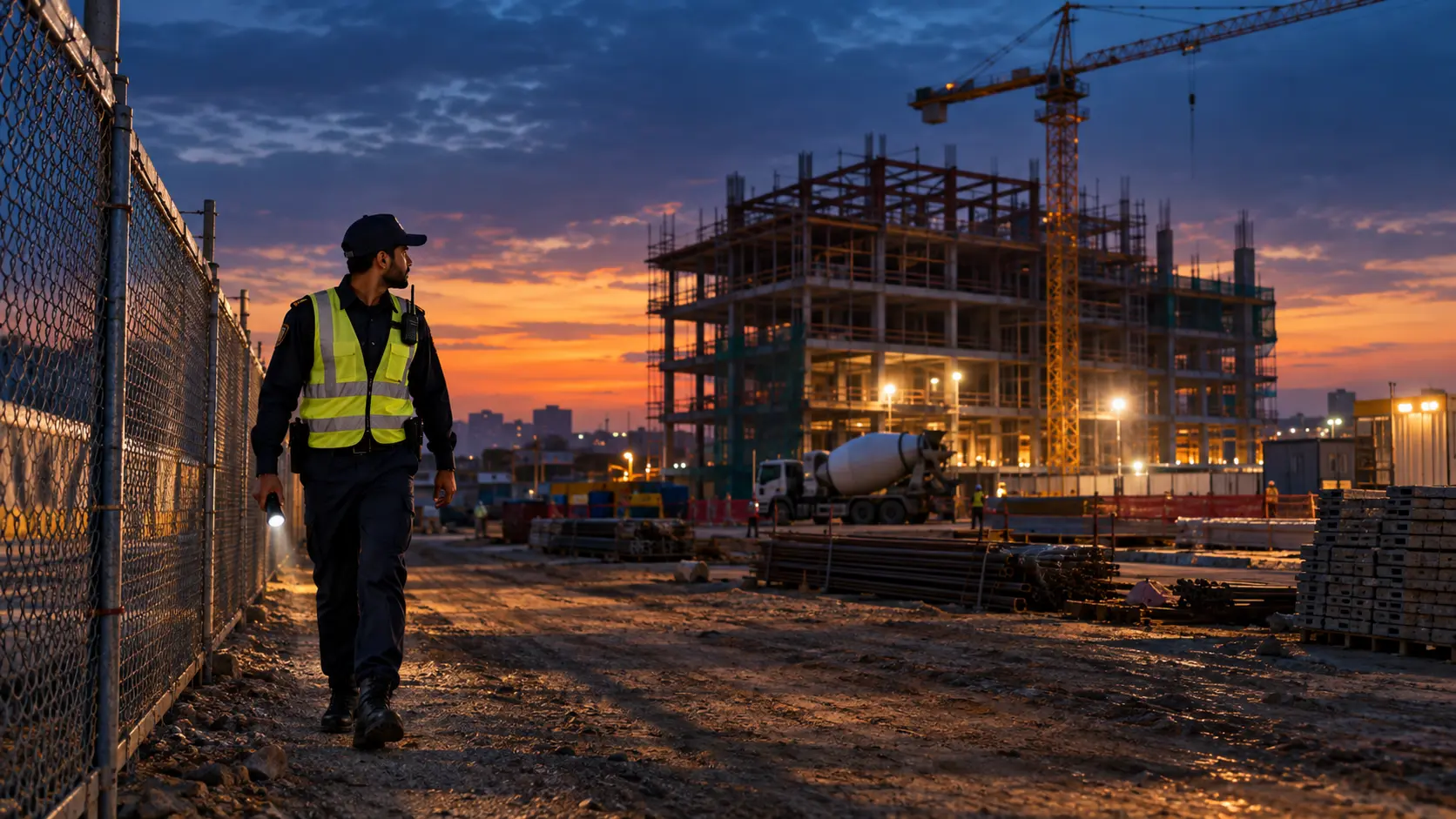
Once the crews leave, the job flips entirely. A property that was full of activity an hour earlier sits empty, dark, and stacked with unsecured materials. Night guards are watching for perimeter breaches, unauthorized entry, and theft attempts, usually with far less backup nearby than a daytime post would have. This is also where steady rounds and staying in touch with a supervisor matter most. A guard who sticks to a predictable route on a large, dim site is easier for an experienced thief to avoid, which is why varied patrols and proper oversight make a measurable difference in what actually stays protected overnight.
What a Construction Site Actually Needs From Its Guards
Not every guard suits this kind of post, and that’s fine. It calls for a different skill set than a typical static assignment.
A construction site guard needs to be comfortable working independently, especially overnight when there’s no supervisor down the hall to check in with. They need enough physical stamina to patrol uneven, often unlit terrain rather than stand at one fixed spot. They should understand basic jobsite hazards well enough to avoid them and recognize when something looks unsafe. And they need sound judgment about who belongs on site, since the answer changes daily depending on which subcontractors are scheduled.
Clear reporting matters just as much. A guard who can tell a site manager exactly what happened, when, and where is far more useful than one who can only say something felt off. That level of detail is what turns a security log into something a project manager can actually act on.
How Clutch Security Services Approaches Construction Site Security
At Clutch Security, we treat project sites as their own category, not a smaller version of commercial security. Every deployment starts with a site assessment, where our consultants walk the property, map access points, identify where materials are stored, and note anything specific to that stage of construction. From there, we recommend armed or unarmed guards based on the actual risk profile, whether that’s a high value equipment yard in Lahore or a residential development in Gujranwala.
Our field supervisors don’t just deploy guards and walk away. They carry out regular site visits to confirm patrols are happening as planned, post orders are being followed, and any issues get addressed before they turn into real losses. Paired with our 24/7 operations center, this gives project managers in Lahore, Gujranwala, Faisalabad, Sialkot, and Kasur a level of oversight that a single unsupervised guard can’t offer on their own.
For projects that need both day and night coverage, we can also combine unarmed guards for daytime access control with armed personnel for overnight protection of high value equipment, depending on what the site assessment recommends.
Frequently Asked Questions
Do construction sites need armed or unarmed guards?
It depends on what’s stored on site and how much risk is involved. Unarmed guards typically handle access control, visitor management, and daytime patrols on standard residential or commercial builds. Armed guards are more common for sites holding high value equipment, working in higher risk areas, or running extended overnight shifts where visible deterrence matters more. A proper site assessment should determine which option, or which mix of the two, fits a given project.
How many guards does a typical construction site need?
That depends on the size of the property and how many access points need watching at once. A small residential build might get by with a single overnight guard, while a large commercial project with multiple gates often needs a team covering different zones across shifts. This is exactly why a site assessment comes before deployment, not after.
Can I hire security guards for construction sites for night shifts only?
Yes. Many projects only need coverage once the crew leaves for the day, since that’s when the property sits empty and unsecured. Night only contracts are common and can be adjusted as a project moves through different phases.
What should I check before hiring a construction site security company?
Ask how guards are trained specifically for jobsite hazards, not just general security duties. Confirm whether field supervisors actually visit the site during the contract, and ask what happens if a guard needs replacing partway through a shift. A provider that can’t answer these clearly probably hasn’t thought through what a project site really needs.
Protecting Your Project From Groundbreaking to Handover
A construction site changes shape every week, and its security needs should change right along with it. Whether you’re breaking ground on a new development or trying to close a gap that’s already cost you materials, the right guard team is often the difference between a project that stays on schedule and one that keeps absorbing losses it didn’t need to.
Get in touch with Clutch Security Services for a site assessment, and we’ll recommend a guard setup built around your actual project, not a generic package that was never designed with a job site in mind.